Category Archives: Special Needs Parenting

Five Ways to Support a Parent in Medical Crisis

“Counting Hand Sign” by Teerapun courtesy of FreeDigitalPhotos.net

A friend loves at all times, and kinsfolk are born to share adversity. (Proverbs 17:17 NRS)

Parents of children with frequent health crises and hospitalizations can easily become socially isolated. Family, friends and congregations often would like to help, but may not know what parents need. Parents may not even know themselves what would be helpful. Here are a few basic suggestions for offering support:

  • Parents often enjoy company. Compassion fatigue can be a real challenge for families. Even though hospitalizations may be a frequent reality, each one is due to a critical medical need placing parents under tremendous stress.  Parents spend countless hours on edge and in need of distraction. A friendly face at the door can be a real blessing. Contact them first to let them know you would like to stop by if they want some company and ask what time is best for them.
  • Offer to help, and be specific. I catch myself at times saying, “Let me know if you need anything.”  I mean what I say, but the offer is so vague that it almost never accepted.  It is better to be specific and ask if there is something in particular they need, or make an offer that is clear. “I’d like to bring a meal on Monday or Wednesday,” or “I can pick up your youngest child from school and bring her to my house for a play day,” or “I will be running errands all day Friday and would be happy to pick up your groceries or other things you need while I’m out.” Also, offer your prayers and be specific.  Ask parents how you can pray for them that day. The medical situation may be constantly changing with new concerns each day.
  • Check in regularly. A phone call or text message letting parents know you are thinking of them is helpful. Or if a parent is inundated with too many contacts (far too often this is NOT the case), offer to be a liaison sharing information with others, coordinating meals, transportation and other needs.
  • Hospital stays are expensive. Apart from medical costs and deductibles, paying for parking and meals adds up quickly. A gift basket with snacks, gift cards to local restaurants, or even a Visa gift card help defray some of those expenses. Many congregations have a hospital parking fund to which members can donate and then pastors pass the funds on to families as needed. If your church does have one of these, look into what you can do to help start one.
  • Families under stress need respite. A parent may be unwilling to leave a bedside unless another adult is constantly with their child. Once the child is home again, the effects of the stressful situation often remain. Parents need an opportunity for a break. Offering to stay with a child gives couples and single parents a chance to get away. If parents prefer to tag-team, with one staying home, moms and dads appreciate an invitation for a girls or guys night out. Even a few hours away with a good friend is a real blessing.

These are just a few ways in which families need support. The best way to know what is most helpful is to ask. Please feel free to share other suggestions in the comments.

Loving God, thank you for those who walk along side us when we need help the most. Guide us to return the favor in a way that is pleasing to you. Amen

“Counting Hand Sign” by Teerapun courtesy of FreeDigitalPhotos.net

Rev Doc Lorna

There Are Plenty of Things More Painful than a Root Canal

“Discourage Or Encourage Keys” by Stuart Miles

Therefore encourage one another and build up each other, as indeed you are doing. (1Thessalonians 5:11 NRS)

Honestly, a root canal is no big deal. I had one 13 years ago, and then had it retreated on an emergency basis last week when that one failed.  All I experienced was relief, though there was one moment of great discomfort…

The doctor and his assistant kept a running conversation while I was in the chair, involving me at times with questions that could be answered by grunts and shrugs.

The assistant told of her two year-old daughter and her precocious language skills.  “We were at my son’s soccer game this weekend and my daughter was talking away.  She was talking in sentences early and has progressed to whole paragraphs. There was a dad near us who commented on what a good talker she is.  He pointed to his son, ‘This one is three and hasn’t said a thing.’ Then he hit the boy on the side of the head.”

It wasn’t long after that the doctor noticed a tear in the corner in my eye, “Are we hurting you?”

Yes, but not in the way you think.

My heart still aches for the young boy with a speech delay and a parent who is a bully. Is he receiving early intervention for his delay? I doubt it.  I could be jumping to conclusions, but reading between the lines I see a parent’s ego tied up in his child’s abilities. When those abilities don’t match his standards – whack! That “playful” whack was painful enough.  I hope that he does not also receive ones that are harder when others aren’t around to see.

It is normal for a parent to feel grief for a child with differences, and part of the grief process is denial. Denial can be helpful in some ways.  It guards us from what we cannot yet process and accept.  We are, however, not meant to dwell in the land of denial forever. It can be harmful to ourselves and those around us.

Maybe if that parent moved out of denial and into acceptance the conversation would have ended like this, “Your daughter is so inspiring.  My son is working hard to get some words. He has a great therapist. I know it will happen for him someday.” In my mind’s eye there is a hug in there too.

While finding the courage to face a diagnosis can be painful, it opens the door to become an encourager. A person who encourages also empowers. The Apostle Paul set an impressive example in encouraging.  Paul writes again and again to his churches, offering to “strengthen and encourage” them. Variations on the word “encourage” appear thirty times within Paul’s letters and the story of his ministry in Acts. He wrote to people being persecuted.  He wrote to people who mourned the loss of loved ones.  He wrote to people trying to follow the spirit of the Jesus’ teachings, but getting it wrong at times. If needed, Paul would admonish and correct, but he always followed up with encouragement. He went back to his churches and visited in person, or sent his friends, so that others wouldn’t feel alone in their struggles.

In part because of encouragement offered to the early followers, a rag tag band of persecuted people persisted and overcame hardship in order to share the good news of Christ. Encouragement empowered them to live up to their potential.  A little encouragement changed the world for the better.

And so, too, can it change the life of a child.

Encouraging God, I thank you for the parents who encourage their children in all things. I pray for the children who need an encourager and ask you to send your messengers with words of hope and understanding. Tear open the veil of denial and create a pathway to acceptance. Amen

Image “Discourage or Encourage Keys” by Stuart Miles curtesy of FreeDigitalPhotos.net


The First Shall be Last

Juegos_Mundiales_de_Verano_de_Olimpiadas_Especiales,_Atenas_2011

I admit it, I was a little star-struck along with Jolene Philo of Different Dream ministry.  We shared an exhibitor’s table at The Accessibility Summit, a disability conference that we both attended at McLean Bible Church outside of Washington, D.C.  We were busily answering questions about our ministries when Jolene turned to me and said, “We need to get going.  I don’t want to miss the keynote. I’m excited just to be in the same room as a member of the Kennedy family.” Me too, Jolene!

Tim Shriver, CEO of the Special Olympics, shared the story of his Aunt Rosemary and her life with intellectual disability, as well as the founding of his organization by his mother, Eunice Shriver. Rosemary lived in a time when disability was even more isolating than today. Her mother Rose Kennedy spent untold hours looking for support and resources for Rosemary with little success. Eunice grew up hearing her mother say time and again, “There is nothing for Rosie. Nothing. Nothing.”

Eunice Shriver set about changing that, founding the Special Olympics. On July 20, 1968, Eunice opened what was then known as both the “Chicago Special Olympics” and the “First International Special Olympics Games.”  Held in Chicago’s Soldier Field, about 1,000 athletes with intellectual disabilities from 26 U.S. states and Canada competed in track and field, floor hockey and swimming.

A decade earlier, people with intellectual disabilities weren’t even being educated. Thanks to Eunice Shriver and her team, they were running, jumping and swimming in Soldier Field.

At the first Special Olympics a group of athletes lined up on the track and raced with joy in midst of the thrill of competition. Rounding the corner to the homestretch with the finish line I sight, the athlete in the front tripped and fell.  All the other runners went past him lying on the track. But then one stopped. The one who was in second place turned around and went back to help up his friend and they crossed the finish line together.

He could have been first.  He chose to be last.

No one remembers the names of the young men on the track that day, but the timeless beauty of true friendship and compassion will not be forgotten.

Then they came to Capernaum; and when he was in the house he asked them, “What were you arguing about on the way?” But they were silent, for on the way they had argued with one another who was the greatest. He sat down, called the twelve, and said to them, “Whoever wants to be first must be last of all and servant of all.”  (Mark 9:33-35 NRS)


Loving God, thank you for friends in our lives who come besife us when we fall and help us get back up again. Amen

Photo By Olimpiadas Especiales México (Own work) [CC BY-SA 3.0 (http://creativecommons.org/licenses/by-sa/3.0)%5D, via Wikimedia Commons

Hope and Acceptance


 Special Needs Parenting Cover


Recently I published the first in what I plan to be a series of books providing suport to special needs parents.  Today I am sharing an excerpt from the final chapter.

For surely I know the plans I have for you, says the Lord, plans for your welfare and not for harm, to give you a future with hope. Jeremiah 29:11

In my own parenting experience I live the tension between encouraging my son Craig to reach out for new developmental milestones and to accept the reality of life with autism. It is a fine line. Embracing a new hope for him, dreaming different dreams, comes out of acceptance of the reality of autism. What are his limits? Even as I encourage him toward new skills, are they beyond his capacity? Do I push for too much? Academically, my son has achieved levels far beyond what diagnostic testing indicated as his capacity. He has gained levels of independence we never thought possible. One of his Craig’s greatest gifts to me was a simple statement he made after he graduated high school. “Thanks for pushing me to try so hard. I did things I never thought I could do. You believed in me when I did not believe in myself.”

Temple Grandin, a popular speaker with autism, recently said at a conference that the best things parents can do for their kids with autism is push their abilities and keep striving for that next milestone. How much is enough? Where is the line between acceptance and hope versus denial of real limitations?

A parent recently told me that she struggled with acceptance because it feels like giving up. I can understand that. It can be hard to say, “It is what it is and cannot be changed,” because that involves letting go of parts of an anticipated future that feel very real. Hope in tension with acceptance embraces the new and different reality of special needs and seeks the new possibilities within it. The words of the serenity prayer are very wise:

God grant me the serenity

to accept the things I cannot change;

courage to change the things I can;

and wisdom to know the difference.

 It is okay to accept a diagnosis of autism and okay to hope for, and actively work toward, relief from a particular behavior or acquiring a new skill. One cannot be changed, the other can. The line between acceptance and hope versus living in denial comes with the wisdom of understanding the difference between what can be changed and what cannot. Craig has dysgraphia. Pushing my son to acquire handwriting skills that are beyond the abilities of his brain would be cruel. Encouraging him to learn his assistive technology and find creative ways to communicate empowers him to succeed within his capabilities.

That is an example of hope and acceptance in the midst of my everyday life with two steps forward and one step back. That’s a dance we special needs parents know very well. That place of hope and acceptance exists even in the hardest of parenting experiences. Recently I traveled to experience Rev. Leslie Neugent’s boundary-breaking special needs worship service “Parables” at Wayzata Community Church in Wayzata, Minnesota. It is a worship service with, and led by, families with special needs. Leslie offered a poignant message of hope in the midst of acceptance.

Her son J.J. is extremely impacted by Down syndrome and has fragile health. One of the many times her son’s life balanced on the edge of this world and the next, she asked her doctor, “Will he make it through the night?”

The doctor shuffled his feet uncomfortably, “He is a very, very sick little boy. He shouldn’t.” He thought a bit more, “But he probably will. That has nothing to do with me and nothing to do with you. We are out of the equation. This is between him and God.”

While there is always hope in Christ in all things, the acceptance of God’s love for J.J. and the need to give the control over to God brought peace in the midst of yet another bedside vigil through the darkest of nights. Acceptance of God’s sovereignty brought peace. Now for the rest of the story. Today J.J. is a delightful young man who loves to shake hands and is quite the flirt, though that may be reserved for pastors who bring him blueberry pancakes.

Perfection is Over-rated

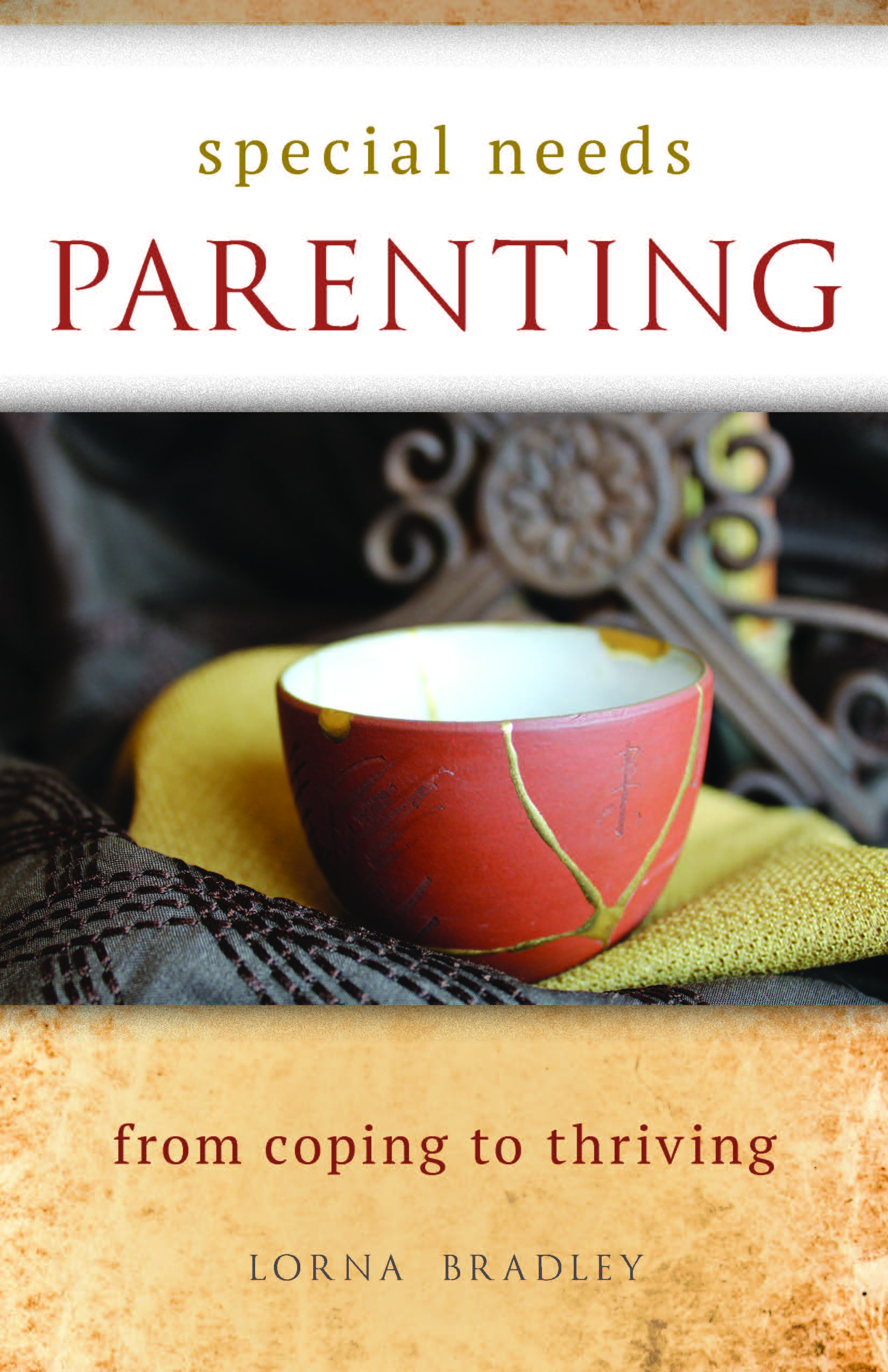
Ours is not a perfect family and for that I can truly praise God. In Japan there is a beautiful style of art called Kintsugi, broken pottery repaired with seams of gold, as seen on the cover of Special Needs Parenting: From Coping to Thriving. Through its brokenness the pottery is made stronger, more interesting, and more beautiful. I think that is what God does through us. God pours his gold into our broken places, making us whole, making us stronger, making us interesting and beautiful in a way that surpasses what others would call perfect.

My hope is that through this book and the suggested tools readers find a new sense of wholeness as parents. They are tools to revisit again and again. Becoming a resilient parent takes intentional focus and it takes time. I pray that special needs parents feel the equipping power of God walking beside them on the journey ahead.

Special Needs Parenting: From Coping to Thriving is available at Huff Publishing.


Feel Like a Sandwich?

Sandwich With Eggplant, Tomatoes, Peppers And Cheese by Apolonia

Honor your father and your mother, so that your days may be long in the land that the LORD your God is giving you. (Exodus 20:12 NRS)

I think sandwiches are great.  So much so, I have become one myself.  Yep, that’s me. Part of the sandwich generation. I have a son who is maturing and gradually needing me less and mother who has a variety of health concerns and is needing me more. My mom took great care of me while I was growing up. I’m glad to return the favor. I recently traveled to care for her during full knee replacement. I had delusions of getting writing done while there. Ha! Knee rehab is a full-time job for all involved.  I did succeed, however, in stocking her freezer to the bursting point with individual portions of her favorite home-cooked meals, plus a batch of homemade strawberry jam for good measure.

Being part of the sandwich generation is a role I’m glad to fill in the midst of being a wife, mother, pastor, writer and speaker. It’s a role that comes with choices. I didn’t want mom to know I was missing my 30 year anniversary in order to be with her, but she figured it out. She knows I keep pretty busy with my ministry, so I spared her the details on deadlines. Nevertheless, she noticed my computer was on A LOT.  Oftentimes those of us in the sandwich generation need to decide between two or more important things, choosing which is more pressing at the moment.  In this case it was not at all a hard choice to make.

Any parent in the sandwich generation feels the extra needs within the extended family. For special needs parents it is more so. We run the risk of being stretched too thin while juggling many needs. On the day of Mom’s surgery it was the fourth day in a row I had woken up in a different place across three different time zones. As my alarm clock beeped rudely I had that disconcerting sense of “Where am I? Why am I here? What time is it?”

I was where I needed to be, with mom, getting her to the hospital on time, calming her nerves and my own. Life went from hyper-speed to the speed of a walker powered by wincing baby steps. Blessings come in many surprising ways.  I took a page from my own book regarding self-care and, once Mom was to the point of having a less painful day, I got out of the house for an hour and a half to run along the coastal hills of California. When my college roommate offered to stop by with lunch I gratefully took her up on it and we enjoyed an afternoon of giggles that was far too brief.

Along about day six or seven after surgery, days filled with multiple ice therapies, massages and stretching, Mom said, “Well, one thing you certainly got right is honoring your mother.  I feel so loved and cared for.”

Yes. I’m where I need to be, and glad to be there. Truthfully, it feels pretty good to be loved and needed by both generations.

Gracious God, thank you for calling me to be where I am needed most.  Help me to be enough. Amen

Lorna Bradley

Photo “Sandwich With Eggplant, Tomatoes, Peppers And Cheese” by Apolonia from FreeDigitalPhotos.net

Hope for Healthy Relationships

Special Needs Parenting Cover

Recently I published the first in what I hope to be a series of books offering support to special needs parents. Today I am sharing an excerpt from chapter six. I hope it is a blessing to you.

But Ruth replied, “Don’t ask me to leave you and turn back. Wherever you go, I will go; wherever you live, I will live. Your people will be my people, and your God will be my God. Ruth 1:16 NLT

Relationships are critically important to personal and family resilience.  Maintaining healthy relationships within the family and developing friendships help create a network of support as well as emotional reserves for current and upcoming challenges. The need for relationships among special needs parents is a large part of my motivation for writing material for use by small groups.  One of the greatest gifts parents who are overwhelmed can receive is the knowledge that they are not alone. The relationships that come through meeting others on the same journey provide meaningful connections and support.

Since healthy relationships are an important part of building resilience in special needs parents, where to begin?

  • Set priorities. Which are the relationships you value most? Which are the relationships most in need of nurture? Spouse? Child? Friends? Set priorities to focus your attention there. A pastor I know shared that he and his wife make an intentional priority to set aside a few evenings each month to nurture relationships with other couples so that they have friendships.
  • Understand the difference between acquaintances and friends. Social media announces our friend count and number of connections. Who can you really count on when needed? Who can hear your disappointments without judgment? Who is willing to work through challenges with you? Do you return the favor? Those are your real friends.
  • Create space for the important relationships. In my household we have “family time” pretty much every weeknight. We read together or watch a show or share a meal. Studies show the simple act of eating together builds family resilience as it engages four relationship building blocks (loving action, time, communication, and healthy boundaries). My husband and I set a priority for a weekly date night. For my most valued friendships I try to keep regular contact and get together as often as possible.
  • Pay attention to the give-and-take of relationships. Are you giving too much and in need of getting something more back? Are you taking too much yourself? Relationships should have a rhythm to them. At times we are in need and at times we are the ones offering support. Relationships that lack a balance of give and take become draining over time for the person who is always in the mode of giving.
  • Enjoy being a parent. Yes, there are therapies to do, medications to administer, schedules to watch, behaviors to observe and modify. Just remember you are a parent and not a caseworker even though it sure can feel that way at times.
  • Set healthy boundaries between you and your child. I often experience among special needs parents a sense of a blurring of that boundary. I have heard the pronoun “we” countless times. “We got a low grade on the math test.” “We had a rough day at school.” “We forgot our medication.” “We had five seizures last night.”

Healthy relationships are an important part of the journey with special needs. In challenging times it is especially important to have a core of support. I opened with a well-known verse from the story of Ruth. Naomi had lost her husband and her two sons, who were also married. In Naomi’s culture, a woman’s status and security resided in her connections with the men in her family. Her worth was tied to fertility. All three of the widows were in a precarious situation, but especially so for Naomi. Unlike Naomi, her daughters-in-law were young and could hold onto hope of another marriage. Yet, in the midst of the darkest of times Naomi had a core relationship with her daughter-in-law Ruth that provided support. The health of her relationship with her daughter-in-law revealed itself in her Ruth’s fierce loyalty. Their mutual support sustained them both through the hardest of times. It may seem difficult to set a high priority to build healthy relationships with so many other pressing needs. However, healthy relationships are a key tool to personal resilience for the journey ahead.

Special Needs Parenting: From Coping to Thriving is available at Huff Publishing.

When Every Day is Autism Awareness Day

Autism Awareness Day

Is it already World Autism Awareness Day? The year just flew by, but then again it is autism awareness day everyday at my house. Last year my grand experiment in building awareness got me a little more than I bargained for…

On Wednesday, April 2 2014, I joined in with celebrating World Autism Awareness Day. The tagline of the day was “Light it up blue!” and so I did.  I updated Facebook with a blue cover photo and profile pic, all promoting autism awareness. I also dressed in blue, celebrating the many people in my life impacted by autism, including my son.

Figuring out what to wear was a bit of a challenge.  I discovered at the last minute that I do not have much blue in my professional wardrobe, but one royal blue cardigan peeked out among a rack of long sleeves. Putting it on, I recalled something else I own that went perfectly with that royal blue sweater, a magnificent fascinator filled with feathers and tulle. I bought it for a trip to the Kentucky Derby that never happened. Just the perfect thing to add a bit of whimsy to a day of celebration for friends whose lives could use to be celebrated publicly much more often. Upon arrival at the office, I clipped on the fascinator at the oh-so-perfect, jaunty angle (no small task that!), snapped a selfie, posted it and tagged my many friends whose lives are touched by ASD.

Originally, I meant to remove my hat after the selfie. I felt a bit self-conscious in the office.  I thought, “If I wear this hat, I’m going to get funny looks and have to explain it all day long.” Then again, isn’t that what an AWARENESS day is for? Creating awareness?  If I just wore blue, I reasoned no one would think that was out of the ordinary. But sporting a headful of feathers and tulle? That’s a whole other matter!

What started as my grand social experiment in creating awareness became something else entirely by the end of the day. At first, it was kind of novel. I encountered the anticipated funny looks and immediately explained to each person why I was wearing a hat. By the time I had done it, five times, ten times, the novelty faded.  It got to the point that I skipped over a few opportunities for explanation and just walked on by, accepting the funny looks and occasional humorous comment.  By noon I found myself almost hiding in my office, knowing that another trip down the hall would be another encounter.  It grew old getting odd stares.  I debated removing my hat. It would have been so easy to just take it off and be “normal.”

I wonder how often people with autism wish they could simply take it off. Wouldn’t it be nice not to get the quizzical looks for behavior that isn’t what others expect? Even just for a while? As a parent of a son with Asperger’s, I’ve felt those stares weighing on me and on my son, especially when he was younger. That repeated question from those who don’t understand, “Why can’t he just (fill in the blank – behave, be quiet, eat what everyone else is eating, etc.)? Well, the answer is he can’t, at least not on that day.  It’s not a choice.  Asperger’s, like other special needs, is not something that can be taken off. My hiding in the office and avoiding the break room reminded me of times when my son was young and I longed to take him to the playground, but knew that was not a place where he met with much success. I would gaze out my dining room window toward the playground. If there were other children and parents there, and it had been a challenging day, I knew we just couldn’t go that day.

In the parent support groups that I lead, we’ve all experienced times when we get tired of receiving “the look” and choose to withdraw. It’s easier to be alone, or so we tell ourselves.  It is really isn’t. We are made for community. It reminds me of the story in the Gospel of John.  Jesus was walking through Samaritan territory and he stopped at a well in the middle of the day while it was hot and no one else was around.  Soon a woman came, one who chose to isolate herself from stares and whispers, coming to the well in the hot afternoon sun when others were at home. It was easier for her to be alone, too. But it really wasn’t. And Jesus knew it. By the end of her conversation with Jesus, she was restored to community. So eager was she to get back to her people, that she left her water jug by the well and ran all the way back to her village, inviting others to come and see Jesus for themselves. That is what Christ does for us. He restores us and calls us out of isolation and into community.  Yes, even us with lives touched by special needs.

This reminds me of the amazing story of a church that embraced Max and Emily Colson. Emily posted a blog that went viral sharing her experience of a cruel movie audience that heckled, jeered and mocked, driving Emily and her son Max out of the theater due to Max’s autism. Their church stood beside them and rented out an entire theater so that 500 people could attend Movie with Max.  Their church celebrated autism awareness, not with a splash of blue, but by embracing and including.

Our need for inclusion and understanding is part of the fabric of our beings of which we are wonderfully woven by God. Living into inclusion involves creating awareness in whatever way we can, whether at a movie theater with 500 of our closest friends, or wearing a silly hat to the office. When we stay engaged, even when it is hard, it is one more chance to shine the light of Christ for the ones in our lives who put the “awesome” in autism.

 Lorna Bradley

Special Needs Parenting Introduction

 Special Needs Parenting Cover

Today I am sharing with my readers an excerpt from the introduction of my book, Special Needs Parenting: From Coping to Thriving.

I have hit the bottom of the tank today. We had our annual review at the school, and it’s so hard to hear in concrete terms how delayed my son is. I know it. None of this information is new, but it’s so hard to hear again. I worry about his future, let alone how we will afford all of his therapies today. Every single day there is so much to do that I feel I can barely keep up. The needs are unending, and I am not nearly enough.

—Blog Post, Anonymous

 Have you ever been that parent? I have. My experience isn’t exactly the same as my friend’s recent blog post, but it resonates in many ways. Challenging behaviors at school? Yes! Worry about my son’s future? Yes! Endlessly running around to therapy appointments? Yes! A sense at times of being overwhelmed in day-to-day parenting? Yes! A view of the future shaded by anxiety? Yes!

Our journeys as special needs parents are as varied as the differences among our children. Each child is unique and precious in the sight of God, and there is no other exactly like our own. Yet there are common challenges and common experiences shared among us as special needs parents. As clergy, I have led a variety of parenting support groups for more than five years and it never ceases to amaze me that, regardless of how varied the diagnoses within each family, there are common cords that bind us together emotionally and spiritually. Throughout the years I have seen healing of deeply held emotional and spiritual wounds through coming together in a supportive, welcoming Christian community and working through our challenges together.

My journey toward writing Special Needs Parenting: From Coping to Thriving began years ago when members in my congregation asked me to lead a Bible study for special needs parents. I looked for a resource I could grab off a bookstore shelf that would address the emotional and spiritual concerns of the special needs parents and had limited success. I was in the midst my studies in a doctoral program at the time and I realized that I had found an area of tremendous need for resources within the church. This epiphany changed not only my academic focus, but the trajectory of my ministry.

Through my personal journey as a special needs mom, my experiences as clergy walking with families with special needs, and academic research into how best to build family resilience, I developed a seven-week study. Each chapter addresses a common challenge and offers a positive perspective grounded in scripture and practical tools that can be revisited again and again.

  • God and Special Needs
  • Understanding Chronic Grief
  • Breaking Free from Guilt
  • Tools to Increase Patience
  • Self-care for Caregivers
  • Building Healthy Relationships
  • Hope and Healing

Whether parents read Special Needs Parenting: From Coping to Thriving as part of a small group study or read it individually, I pray this book provides both insights into a loving God and practical tools for the journey ahead. Encouraging special needs parents is at the heart of my calling in ministry, and I hope that the book will be a blessing.

Next week I will share a passage from chapter six, Building Healthy Relationships.

Special Needs Parenting: From Coping to Thriving is available at Huff Publishing and Amazon.

Blessings,

Lorna

Book Release!

Books Arrived Watermarked

In many ways, writing a book is much like having a baby.  It involves a very long process of development and much excitement and anticipation toward the end until, finally, the day arrives.  I am delighted to let my blog readers know Special Needs Parenting: From Coping to Thriving has been released.  I wrote this book to offer emotional and spiritual support for parents and loved ones on the journey with special needs as part of living out my calling in ministry. The Hope and Healing Institute where I work has offered tremendous support to me during the research and writing process.  It has been a wonderful journey as I developed pilot support groups through a variety of settings. I have been blessed to meet inspiring parents and the time we spend together each week has been filled with holy moments, feeling the presence of God working within the lives of individuals seeking nurture and support.  The shared laughter and tears as we wrestle with some of life’s greatest challenges has forged friendships that will no doubt continue for years.

Special Needs Parenting is just making its way into distribution channels, yet as I spoke at the Faith Inclusion Network conference in Virginia Beach this past week I had my first encounter with a person who had already ordered my book. He attended my workshop and talked to me afterwards, telling me about how he plans to use the book in his ministry to special needs families.  In a way, my “baby” is taking its first toddling footsteps out into the world. It is nice to hear there are embracing arms waiting to welcome it!

In writing this book I opened a window into my private life as a special needs parent and share my journey freely with others.  I have been asked, “How on earth do you get the courage to write a book like that?” I understand the question. This book is written from a place of great vulnerability and I made a conscious decision to do so.  The reality is that all parents on the special needs journey regularly experience that vulnerability.  Is there a place for me and for my child?  Will we be accepted? Will we be judged for our differences?  As parents we can become fiercely protective, with the side-effect of also becoming isolated. In the willingness to share our vulnerability with each other, openly encountering in community our common emotional and spiritual challenges, we find there connection, understanding and healing. If I cannot reveal myself to my readers, how can I expect them to go without me to that vulnerable place of hope and healing?

In the coming weeks I will share excerpts of Special Needs Parenting: From Coping to Thriving in hopes that they will be a blessing to you.  If you would like to know more about Special Needs Parenting, click here for my website.  There you can learn more about the book, read feedback from past participants and discover what other disability ministry leaders have to say about this resource. Currently the book can be ordered through the publisher Huff Publishing and Amazon.

Blessings,

Rev Doc Lorna


Wandering Through the Woods

Weston Woods Watermarked

He said to them, “Come away to a deserted place all by yourselves and rest a while.  (MarK 6:31 NRS)

This past weekend I had the opportunity to lead a retreat in the country.  We were a small gathering, but every person arrived with a sense of needing respite and renewal. Each left refreshed, armed with new tools of self-discovery and a sense of community.

The first day, with dry weather and an open afternoon, allowed time for exploration of walking paths on gently rolling hills past ponds and hay fields.  I came across a little worn path, Weston Woods.  My curiosity got the best of me as I stopped off the main, well-groomed trail and began meandering through the woods. Up and down I went, past creeks and the remains of bonfires of the past. The other paths were recognizable, carefully explained to me by my host.  But this path was unfamiliar and rugged. The solitude embraced me, my mind wondering all the while, “Why am I on this path? Should I be here? What lies ahead?”

The tracks of the deer put me at ease. The lasting impressions of their sturdy hooves in the soft soil told me I was heading someplace familiar to many, if not to me. The trees were so thick that I couldn’t see very far down the path where I was headed, but I trusted the ones who had gone there before to guide me. The reward for my patience revealed itself in an open meadow with one spectacular and ancient oak holding court in the center. How wonderful are the works of your hand, O God! Such beauty tucked away as a jewel awaiting discovery. The peaceful shade under its wide branches echoed to me Christ’s words, “Come away to a deserted place all by yourself and rest a while.”

My journey as a special needs parent reminds me of my time in the woods.  It was a world I entered by stepping off the familiar path of parenthood that I had expected, that one reserved for “typical parents” and for which I had carefully prepared.  I found myself wondering, “Why am I on this path? Should I be here? What lies ahead?” Even as I felt a little lost, I trusted the trailblazers who had gone before, following along in their footsteps. Moments of loneliness and shadow giving way to beauty and joy, discovering anew God’s promise that all of creation is beautifully and wonderfully made. My role is to trust and follow and allow the journey to unfold.

Guiding God, Thank you for leading when we cannot see the way. Thank you for renewal when we feel tired. Thank you for surprising us with beauty in unexpected places.  Amen