Just One Friend Part 2

Calhan_Colorado_High_School_Cafeteria_by_David_Shankbone

Some friends play at friendship but a true friend sticks closer than one’s nearest kin. (Proverbs 18:24 NRSV)

Everyone wants and needs relationships. We are hard-wired for it. One of the biggest hurts I have felt as a parent is wanting my child to feel accepted and connected to others. In the support groups I lead it is a common issue that resurfaces again and again. I talk to parents about nurturing the relationships they do have and they switch to talking about relationships their children don’t have. I have been mulling around an idea that has not really taken shape yet, but it goes something like this. Wouldn’t it be great if churches could host a “Just One Friend” night. Invite the special needs community and anyone else who is looking for friendships. Set up games and activities. Parents stay and help foster connections. This in’t a respite night. It’s a relationship building night. Kids build relationships with kids.  Parents build relationships with each other. The general premise is that folks are coming to have fun and meet new people that they may want to connect with after game night is over. That’s kind of a bare bones snap shot, but I think it could be a way churches could offer important relief from isolation, which is a big part of healing on the journey with special needs.

Here are a couple of practical strategies I used for nurturing friendships when my son was younger. I recognize that this is not a universal list for all the various differences amongst our children. Hopefully it will at least provide some fertile ground for other ideas to spring up as well:

  • Remind your child that everyone will be looking to meet new people. They are not alone in that feeling of being in a class with new people.
  • Have your child talk to kids who are friendly and suggest they ask them questions. Kids love to talk about what they did over the summer. Be an interested listener.
  • Have them look for others who look lonely and talk to them. My son can spot a kid on autism spectrum in heartbeat. Like matches with like sometimes.  They get him in a way others don’t.
  • Have them make friends with grownups at school. The cafeteria monitor can be a great ally in finding friends and avoiding bullying.
  • Dress like everyone else. This sounds basic, but it is amazing what an impact it can have if a child is “over-dressed” for school, especially boys. If they look like they came from a fashion shoot for children’s resort wear change their clothes!
  • If you feed them they will come. If Craig had a friend over in elementary school (not an everyday occurrence!) I’d ask his guest what was his or her favorite cookie and then bake them while the kids played. Over the years Craig’s friends started calling our house Craig’s Pub. As teens, I started calling them the herd that comes to graze. BTW – 5 grazers coming for a half day video game birthday bonanza this weekend. (Number of gamers times number of pizza slices I think they want plus an extra two per person because they are boys divided by the number of slices in a large pizza…) Prayers appreciated that I don’t get trampled in the kitchen!
  • In keeping with the above strategy, drop by once or twice a month to the school cafeteria with a couple of pizzas or one of those giant cookie cakes. Some folks grab a slice and run. Others grab a slice and stay.
  • If you typically pack a treat in your child’s lunch, pack two so that they have an extra to share.
  • Invite others. Waiting around for a playdate invitation that doesn’t come feels lousy. Make the effort to extend yourself. Sometimes there will be rejection, but other times you get a winner.
  • Be intentional about fostering relationships. Even small acts of kindness are nurturing.

What are some friendship strategies that have worked in your household? Please comment and share ideas.  You never know what may help another parent spark a friendship.

Prayer: Loving God, We are wonderfully made to be in connection with others.  Please help those connections to grow among our children. Calm nervous feelings about meeting new people and open pathways for meaningful relationships to flourish. Amen.

Photo: “Calahan Colorado High School Cafeteria” by David Shankbone
Just One Friend Part 1

Calhan_Colorado_High_School_Cafeteria_by_David_Shankbone

Some friends play at friendship but a true friend sticks closer than one’s nearest kin. (Proverbs 18:24 NRSV)

Didn’t summer just start last week or the week before?  Yet there they are. Ads in the paper for back-to-school supplies. My Facebook feed is full of friends caught up in back-to-school preparations. Friends who are teachers are posting pics as they fit in one more vacation before the new school year.

As a special needs parent, back-to-school comes with an oddly mixed sensation of anxiety and hope. I am always hopeful for a new year and new possibilities.  It’s the “what if” gremlins that make me anxious. With a little experience I finally figured out the first day of school routine.  I pray my son out the door with a positive, “God’s got you, so you’ve got this!” and keep the anxiety part to myself as I sit by the phone and wait for the call from the school office.  Autism and the first day of school. The call was inevitable at my house. I learned just to go with it.

My biggest prayer for my son each year is to make one friend. Just one. One good friend will see you through anything. Barnabas traveled with Paul on long and dangerous journeys to share the gospel.  Moses had Aaron on his journey to and from Egypt. David had Jonathan through battles and political intrigue. Of course my dreams were more sedate. I simply prayed for a person to sit with my son in the cafeteria and maybe hangout to build Lego castles and help save the world in the latest video saga. 

Looking back over the years that prayer has been answered each year. Some of those kids my son connected with in elementary school are still friends after high school. Some are neuro-typical.  Others are not. In the long run those differences matter little between real friends. The truth is that sometimes friendships bloom out of the most unlikely connections if well-nurtured, though I did give Craig one piece of advice that really helped.  Look for the kid who is by himself at lunch and go join him.  I bet he would like to have just one friend too.

Check back tomorrow for my post with practical strategies for helping our kids make friends.

Prayer: Loving God, Watch over our children as they look for friends.  Create pathways for connections where they feel loved and accepted.  Amen.

Photo: “Calahan Colorado High School Cafeteria” by David Shankbone
Just Horsing Around

Steeplechase_(2018245)

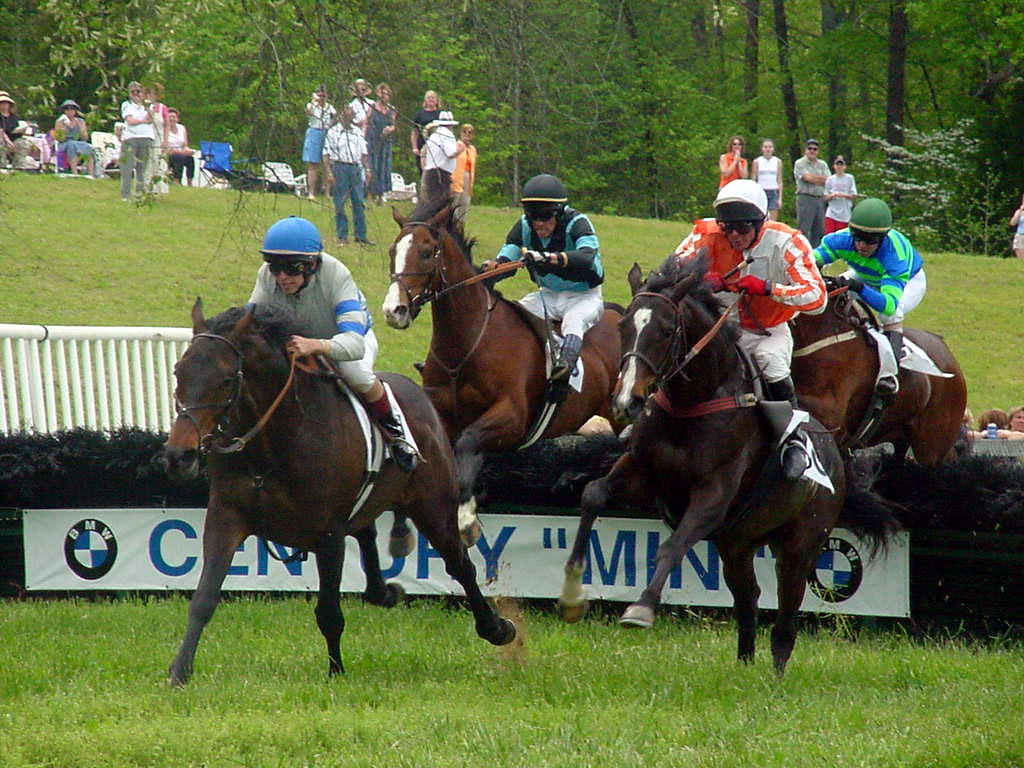
If I had known the day was going to include a life or death, headlong, downhill race after my son, I would have worn different shoes.  In hindsight, I should have seen it coming.

We moved to Chicago from Alaska while my husband attended graduate school. Living on a tight, student’s budget, we were happy to find a family friendly event in the neighboring town of Naperville, an annual steeplechase.  It was a day in the country with horses jumping over fences (be still my heart!), gorgeous fall foliage, and a hillside picnic where our high-energy, high-rise dwelling three year old with ASD could enjoy the great outdoors and fire his afterburners. Perfect! Thinking it might be a fancy horse event, I wore casual slacks and flats.  That was mistake number one. Oh, I was dressed just like everyone else, but…

We parked in the freshly mown hayfield and climbed the hill to find the ideal place for Craig to run and play, spreading out our blanket with the perfect view of the finish line. Opening our picnic hamper, we settled in for the first race. Eight brush jumps, a beginner round taken at an easy pace.  Craig watched the horses jump the first few fences, bouncing away in my lap on his imaginary horsey, and shouted, “My turn!”

I thought he was joking.

That was mistake number two.

Back in the day in Alaska I rode horses and my husband would meet me at the barn with our son.  After I had finished my ride, we’d buckle on a helmet and Craig would sit in the saddle in front of me, kicking his tiny feet, “Go Alex, go!”  Each time he got to the barn, he’d see me jump a fence or two, call out, “my turn!” and he’d get a ride.

You know how kids with ASD are about routine?  Well, I hadn’t figure that out yet.

He jumped out of my lap and started running down the hill, “My turn!  My turn!”

I called after him that he couldn’t ride those horses, thinking he would stop. Ya, right. All I managed to do was let him get a head start.

That was mistake number three. Game on!

Mommy instincts finally kicked in.  He’s not stopping!  His tiny legs had remarkable turnover as he sprinted for the finish line.  “Craig! Stop! The horses are coming!”

“My turn!”

Dear God help me! No one else knew what was happening. The rest of the sparse crowd had their attention fixed on the finish line. I started running faster, flats slipping on the damp grass.  My husband, realizing the seriousness, was on his feet behind me.  There was no time to zigzag around the other picnicking guests.  I leapt entire families in hurdler form, screaming like a crazy woman, “Craig! Stop!”

“My turn!”

All dignity gone, feet skidding wildly, I finally managed to scoop up Craig about ten yards from the rail. Frankly, I was glad I didn’t fall on him and crush him.

Relieved. Scared. Embarrassed. Elated.

I tucked him under my arm like a wiggly football, full of giggles for his great adventure,  and started the long trudge back up the hill to scattered, polite applause, apologizing to far more people than I care to remember. I was embarrassed, they were amused.

I realized in that moment how deeply I loved my child.  I couldn’t think of logical consequences for a punishment, nor behavior plans. I doubt in that moment I even knew my own name, but I felt an overwhelming sense of love and knew nothing would keep me from chasing after him.

Perhaps that was for me a dim glimpse into the love that Paul writes of in his letter to the Romans.

For I am convinced that neither death, nor life, nor angels, nor rulers, nor things present, nor things to come, nor powers, nor height, nor depth, nor anything else in all creation, will be able to separate us from the love of God in Christ Jesus our Lord. (Romans 8:38-39 NRSV)

Absolutely nothing separates us from the love of God. God loves us in a deep and abiding sense. God, too, pursues us when we are headed the wrong way, flinging wide protective arms, even when we chose not to see them. When we finally turn to Him, He embraces us. “Welcome home, little one! I’m glad you’ve stopped horsing around.”

Photo by Jason Trommetter “Steeplechase” via Wikimedia Commons

Thank you Sandra Peoples for inviting me to guest blog today wiht this post at  specialneedsparenting.net.  If any parents out there are looking for a great book to use for parent support resources, check out Sandra’s book “Held.”

A Place Where Everybody is Welcome!


Coco

God saw everything that he had made, and indeed, it was very good. And there was evening and there was morning, the sixth day. Thus the heavens and the earth were finished, and all their multitude. (Gen 1:31-2:1 NRSV)

A sign I have lived in Texas for a long time: Yesterday my husband came home from work and found me relaxing on the back patio. “My car says it’s 95 degrees!  Aren’t you hot?” I was sure he was wrong.  It felt lovely! I checked the temperature on a weather app.  96 degrees.  Well, he was wrong…

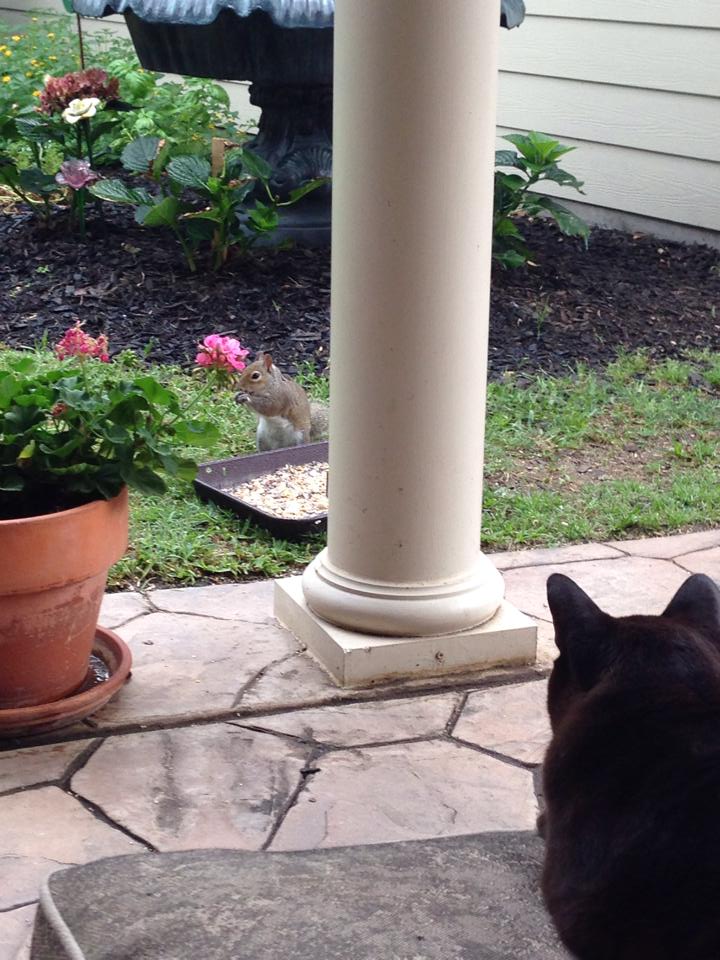
Being around creation recharges my batteries. I simply have to get outside and enjoy the beauty of what God made.  A perfect respite for me is time with my cat Coco, my furry and feathered friends who come to my backyard feeder, and a splashing fountain to provide just the right background music. Bliss!

God made it all and called it good.

We have a highly inclusive bird feeder, which doubles as a squirrel feeder.  I keep it on the ground for more convenience to me and the squirrel. We take everybody who comes and everybody gets what they want.  I think about their needs. Blue Jays? More peanuts! Cardinals? More safflower and sunflower seeds! Mockingbirds? Sliced apples and fresh berries hit the pan.  Our garden is planted to attract bees, butterflies and hummingbirds.  Water, food, shade.  My yard is haven for all and I make sure it is inviting and inclusive to everyone.

Years ago I watched a man feeding doves. He only liked a certain variety.  When ones showed up he didn’t like he shooed them away, kicking sand toward them.  I wonder to this day what he had against those particular birds. Why weren’t welcome?  Granted, they were not as cute, not as agile, not as delicate as the ones he favored, but they were special in their own way. Besides, God made them all and called them good.

Inclusion means making a place for everyone, welcoming whoever comes.  Jesus said, “Let the children come to me.”  He didn’t kick sand at the ones who weren’t “cute and agile.” He made space for them.  All of them. It’s no coincidence that many of the stories of Jesus were about people with special needs. Those were his people. Jesus was inclusive.

All means all.

This past June I met a pastor who leads a worship service where truly “all means all.” Leslie Neugent at Wayzata Community Church in Wayzata, Minnesota thinks outside the box about how to do inclusive worship.  Her service, Parables, is led by and for families with special needs, attracting over 100 worshipers on a typical Sunday. How do they attract so many?  The key is the right invitation.  I don’t mean one they print and hand out, though they likely do that too. I mean Leslie and her team are intentional about thinking about what families need.  A safe place where noises are allowed? Not a problem! A child who wants to be in the center of the action? Fantastic!  The more volunteers the better! Pattern and predictability work best for your family? You got it!  Familiar songs, short sermons, lots of activity for all levels. Check out more Parables worship here for ideas to share with your church: http://www.wayzatacommunitychurch.org/pages/page.asp?page_id=229208

Attraction and inclusion come through thinking about who we care to welcome and then providing a welcoming environment, whether it is a backyard or a church.  God made us all and calls us good, too. I am so grateful to serve our God of inclusion.

Photo: Backyard Friends by Lorna Bradley

May God Bless You and Keep You

Time For Family

Peer pressure, bullying, and simply trying to fit in can lead any child to make wrong choices.  When you add to the mix our kids who can struggle socially due to their differences, the desire to be part of the crowd (or just have one friend – PLEASE!) can pull our kids in directions we certainly would not choose. How do we raise kids who are grounded? At a recent lunch and learn event, Rabbi Ranon Teller of Brith Shalom Congregation talked about Jewish traditions and how they are effective in raising young people who are grounded.  He had my undivided attention. He pointed to three pillars that are part of Shabbat (Sabbath): ritual, Sabbath rest and blessing.

Ritual

On Shabbat, the family gathers for a meal Friday night beginning at sun down.  In this tradition, all family members are present and seated at the table together enjoying a meal without interruptions. No excuses accepted for other things that need attention. A key piece is simply the ritual, the intention and practice of making it a priority to be together. In this, the family disconnects from the outside world and reconnects with each other.  Studies show that over time American families eat together less and less. Conversely, families that do eat together are more resilient and have improved communication between members.  A healthy body happens with intentional regular action. We can say we want to have a healthy body and that it is important to us, but for that ideal to become a reality we need to develop regular practices of healthy eating and exercise.  A healthy body comes through regularly repeated activities. And so it goes for the health of the family. Building family closeness and connection requires regular practices as well, such as the ritual of a gathered meal and time that is set aside just for the family. (Family game night, anyone? Pizza and a movie? Build the best ice cream sundae contest?)

Sabbath

Sabbath is the practice is disconnecting from the business and work of everyday life and setting aside a time of rest.  In the Jewish tradition, part of that rest includes disconnection from technology.  (I hear wailing and gnashing of teeth. Some of that noise is coming from me!)Engaging with technology draws focus and energy away from those gathered together.  Rabbi Teller told of families placing technological devices in a basket and intentionally setting them aside. Disconnecting from iPads, gaming devices, and cell phones encourages deeper connection within the family. I tried it and it really works. On a recent date night my husband and I did something we had not done in years. We left our phones at home. On purpose!

Blessing

In the Jewish tradition of Shabbat, parents bless their children in prayer, often with the priestly benediction:

May God bless you and keep you.

May God shine light and be gracious to you.

May God show you kindness and grant you peace. (Numbers 6:24-26 NRSV)


Showering your child with the gift of regular prayer and blessing teaches them of God’s love, as well as your love, for them. Also, the power of prayer is an amazing thing in the life of a child.  Never under-estimate what God does through prayer.  Prayer itself can become a ritual.  I used to pray with my son every day before he got on the bus to go to school. It was just a brief prayer about asking God to protect him, bless him and give him the ability to handle the day.  Several years into this tradition I started attending seminary.  As I was leaving that first night for class my son came bounding down the stairs and said I could not leave yet because we had not prayed.  He offered a blessing to me, a simple prayer that left me blessed in more ways than one.

What are your family rituals?  Are there ones you would like to start?  How do you take a Sabbath rest and disconnect from the demands of the world?  When and how do you bless your child and family?


“Time for Family” Image courtesy of Stuart Miles / FreeDigitalPhotos.net

Run, Run, Run

Racetrack

“Later you get pie!” Words to live by shouted to me by a cheering spectator as I ran mile after mile in a recent half marathon. Seriously, spending my calorie bank after a race makes me very happy. One of my favorite parts of running races is the motivational signs. Okay, that and the finish line.

I enjoy reading the funny signs along the course:
Better hurry! People are chasing you!
Worst parade ever!
Free bananas ahead!
The end is near! (Held by a person dressed like the grim reaper).

When I am starting to feel a little tired around mile 8 or 10, inspiration is a fine thing:
Never, never, never, give up
Focus on how far you’ve come, not how far you have to go
The voice in your head that says “you can’t” is a liar

Wouldn’t it be great for us special needs parents if we had motivational signs to encourage us with the task of parenting?

To the parent on the start of a quest for a diagnosis: Never, never, never give up!
It took our family 17 years to move through ADHD, OCD, Tourettes, and anxiety diagnoses finally to have a name for all those behaviors. Asperger’s. Someone out there has the answer.

To the parent of a middle-schooler dealing with hormones coming into play and new sets of challenges: Focus on how far you’ve come, not how far you have to go! Infancy gave way to the preschool and elementary years. Those are all behind you now and you have raised a remarkable child. Job well done! Stretch your arm high in the air, bend it, and give yourself a good pat on the back for the awesome job you have done. Look how far you have come!

To the parent who has reached the limit: The voice in your head that says “you can’t” is a liar! Are you taking time to care for yourself? How can you make that a priority? All those folks who say, “Call me if you need anything.” Call them. Really. They want you to because they care. It doesn’t mean you are weak. It means you are human. Even Jesus took a break from time to time to go away for respite so he could return to his work in ministry refreshed and renewed. Plus, he didn’t go it alone. He depended on his friends. If it worked for Jesus, it’s worth trying.

The Bible is full of motivation for special needs parents.

“Run with perseverance the race set before us.” (Hebrews 12:1b, NRSV)
“I can do all things through Christ, who strengthens me.” (Philippians 4:13, NRSV)
“Do not worry about anything…” (Philippians 4:3a, NRSV)
“Come to me, all you that are weary and are carrying heavy burdens, and I will give you rest. (Matthew 11:28 NRSV)

Parenting is a sacred duty and the most important thing we get to do with our lives. As special needs parents, we have a heaping big portion of parenting. Fortunately, we have a heaping big God helping us, cheering us on for the road ahead.

Image “Racetrack” courtesy of Photokanok / FreeDigitalPhotos.net

Please Hear Me

Bend down, O LORD, and hear my prayer; answer me, for I need your help. Protect me, for I am devoted to you. Save me, for I serve you and trust you. You are my God. Be merciful to me, O Lord, for I am calling on you constantly. Give me happiness, O Lord, for I give myself to you. (Psalms 86:1-4 NLT)

My husband and I have the good fortune of commuting together and we enjoy listening to TED Talks to fill the time in the carpool on mornings when the caffeine has not yet gotten on board to create energy for conversations. Recently we heard Afghan war veteran Wes Moore talking about the experiences of veterans returning from war. He said he used to say to soldiers, “Thank you for your service,” because he thought it sounded right. He heard others saying it and so he did too.  He came to realize as a veteran himself that what veterans really need is for someone to hear their story, to understand their experience. Per Wes, often veterans feel ignored and the message they get is that their service didn’t matter.

They feel invisible.

Sound familiar? I never thought before of the connection between veterans and special needs parents, but it is most certainly there. People say things meaning well, “What a blessing!” or “God won’t give you more than you can handle.” To them it sounds right and they feel the need to say something, but to my ears it is not all that helpful to hear.  What is more helpful is the person who sees beyond behaviors to the family, sees beyond diagnosis to the people, and then takes the time hear the story. The simple request of, “Tell me about your week,” sure is much more helpful and meaningful.  We don’t need a knight in shining armor to ride in and fix it.  We just want someone to listen and care that what we do is hard and what we do matters.

I’ve learned in years of ministry with special needs families that when a parent asks, “Do you have some time?” that means they have a story they need to share. I used to feel the need to “fix it.” In time I learned that ,mostly, they need me to sit and listen and pray for them.  That’s all. There is healing simply in telling the story and being heard. Every parent needs someone to sit in compassion with them and hear their story.

One of the things I like most about the Psalms is they are filled with reminders that God hears us. God is attentive to our prayers. God is a good listener, even when we lack the words to speak.

Blessings to you this week!

You can watch Wes Moore’s Ted Talk at:

Learning to Be a Wide Receiver

Kiel-Baltic-Hurricanes-Spieler

I received some good advice via a devotional the other day.  It asked me if I had been a giver for so long that I had forgotten how to receive.  I needed that reminder. I get caught up at times in doing for others. I actually enjoy helping and doing and supporting. I suppose that is how special needs parents are wired.  It’s written into the job description. It’s the side dish that comes with that great big heaping portion of parenting.  Don’t get me wrong. It’s a role I love. I’m just keeping it real. It’s hard to keep up with everything else in life. It’s easy for days to turn into a list of, “I should have… I need to… I wish there was time for…”

My son comes by his love of animals naturally.  When I was growing up there was a lake across the street from my house.  As a child I spent countless hours there feeding the ducks. I loved tossing out whole slices of bread, setting off a feeding frenzy with ducks devouring in seconds with hungry bills, which eagerly turned my direction for more.  So more I gave, to my delight and theirs. More and more and more, until there was nothing left.

There are days when I feel like that slice of bread. Gobbled up and not enough. Not nearly enough.

That’s the time to remind myself about the receiving.  I’m a lousy receiver. I don’t like asking for help.  I once spent over an hour in a library looking a children’s book to use for a children’s sermon illustration.  The librarian was right there.  She even asked if I needed help.  My answer? “No, but thanks for offering.”

Do you catch yourself doing that?  Turning down help that is freely offered, even when you need it?

It’s okay to be a receiver. It is not a sign a weakness. It’s a gift to the givers in the world who need someone to receive their gift.  By not being willing to receive, I take away someone else’s blessing, as well as my own.

In the Gospel of John, the resurrected Jesus appeared to the disciples.

Jesus said to them again, “Peace be with you. As the Father has sent me, so I send you.” When he had said this, he breathed on them and said to them, “Receive the Holy Spirit.” (John 20:21-22 NRSV)

How wise of them not to say, “No, but thanks for offering.”


photo credit:

Kiel-Baltic-Hurricanes-Spieler

by Torsten Bolten

Papa, Patience and Power

Driving

“Create in me a clean heart, O God, and put a new and right spirit within me.” (Psalm 51:10 NRSV)

Throughout my father’s life I saw him change and grow.  He wasn’t always the most patient person, but really, who is?  I can be at the head of the line myself some days. In hindsight ,I think my dad dealt with a lot of stress that he kept to himself.  I was shielded from it, but I think that just made his load heavier at times.  Through the gift of a life well-lived and experiences taken to heart, he mellowed over the years. I remember one time riding in the car with him when he was in his sixties and he missed a stop light.  As he stopped the car, he turned to me and winked, “Now I’m first!  Looking at it that way, it has no control over me. I took its power away.”

That has always stayed with me.  There have been times I have felt powerless in the midst of a situation, especially when watching my child struggle.  I think of my dad’s wise words at times like that. When worry, frustration, grief, etc. get a toehold (or a death grip!), I use my dad’s wisdom of trying to see it from a different perspective. How can I take away the power of something that has negative control and needs to be weeded from my life?

In Psalm 51, the psalmist writes, “Create in me a clean heart, O God, and put a new and right spirit within me.” (Psalm 51:10 NRS)

This is a psalm of returning to God and turning away from sin.  I think that same idea applies here.  Asking God for a clean heart, a fresh start, a new attitude creates a new perspective. It gives the power and glory to God in all things.

Prayer:    Patient God, Thank you for the power to renew and refresh and put our hearts in the right place. Give us a fresh view of the world full of wonderful possibilities. Amen.

Photo: “Driving In Car In Fall” by digidreamgrafix

What’s in a Name?

When my husband and I were anticipating the birth of our son, one of the most important, exciting and challenging decisions we faced as soon-to-be parents was choosing a name.  Finding just the right name for a person is no small task.  We wanted a name that resonated with our family heritage, one that was easy to recognize and spell, yet not too common. For some reason it was important to me that he not have a name that could not be shortened. I know a Michael or two who do not like being called Mike.  That was a lot to consider. Then family members wanted to jump in with their two cents.  Opinions were not welcome! My feelings were that if they wanted to name a baby, they could go birth one themselves.  Inquiries to know the names that made it to the “short list” were not satisfied either.  We didn’t want our choice slanted by outside influence.  What our child would be called was up to us alone.  Bothered by constant inquiries we finally made up a couple of names.  “If it’s a boy, Rufus. If it’s a girl, Babette.” Those names have stuck with us.  We recently attended a murder mystery dinner theater and needed fake names, so my husband and I were Rufus and Babette for the night.

Finally, after much time and consideration, and the foreknowledge that we were having a boy, we chose the name Craig.  Familiar, but not common. Easy to spell. Cannot be shortened. (Ironically, we lengthen it and call him Craiggers or Craigerkins. Go figure!)  It’s also a name that reflects who he is, celebrating his Scottish heritage.  I had a concern that his name, which means “one who dwells in a crag,” would be bothersome to him. A valid concern from a mom whose name means “one who is lonely.”  No worries there for Craig.  The meaning of his name actually turned into a great bonus from Craig’s perspective since he has a profound love of all things dragon.

Names are important.  What we call ourselves matters. What we are called by others matters.  This week I am at the Summer Institute on Theology and Disability in Dallas.  It is a great blend of theological debate as well as practical application workshops shared by 150 participants from around the world.  People with special needs are one of the most diverse segments of the population.  Typically, when referring to any group of people, you want to use the language with which they refer to themselves.  For some, they prefer the term “disabled,” while others cringed.  “Special needs” resonates with some, while others prefer “special abilities.” One person said she preferred to apply the term “handicapped” to herself. My son refers to what I used to call his “learning differences” as his “learning disability.” For those whose bodies function more typically, I was introduced by Dr. Amos Yong to the concept of being “temporarily able-bodied.” Point well made!  In whatever capacity our bodies are functioning today, there is a good likelihood that given time they will come to function differently. Thinking of myself as temporarily able-bodied offers a new lens that increases my awareness of my own vulnerability.

Hearing the various perspectives around the room, I wonder if a person who experiences a difference in the function of their body puts as much care into how they name that for themselves as Mark and I put into naming our son Craig.  Given the strength of opinions, I will say that many do. It’s a naming that needs to be honored for each individual. There is no “one-size-fits-all.” As a parent I would not accept a name for my child that was imposed by the outside.  Nor did I let my child’s life be defined by the names (labels) that come with the journey of special needs.

Names matter and I apply that in my prayer life praying to Loving God, Gracious God, Healing God, Leading God, Nurturing God, God the Father, God the Son, God the Holy Spirit. In an endless number of names I call on God and trust in God’s attentive presence to my prayers. God is so much more than just one name.  When Moses asked God his name so that he could tell the slaves in Egypt who sent him to free them from captivity, God said to Moses, “I AM WHO I AM.” (Exodus 3:14 NRSV).

God is all things and cannot be defined by one name. In that we are made in the image of God, that is an important facet in the quality of God that is empowering to take on for ourselves and for our children.  We are wonderfully made, even in the midst of our many unique expressions and differences.  We are who we are, transcending the labels with which others may seek to define us.