Tag Archives: Lorna Bradley

Just a Typical Day

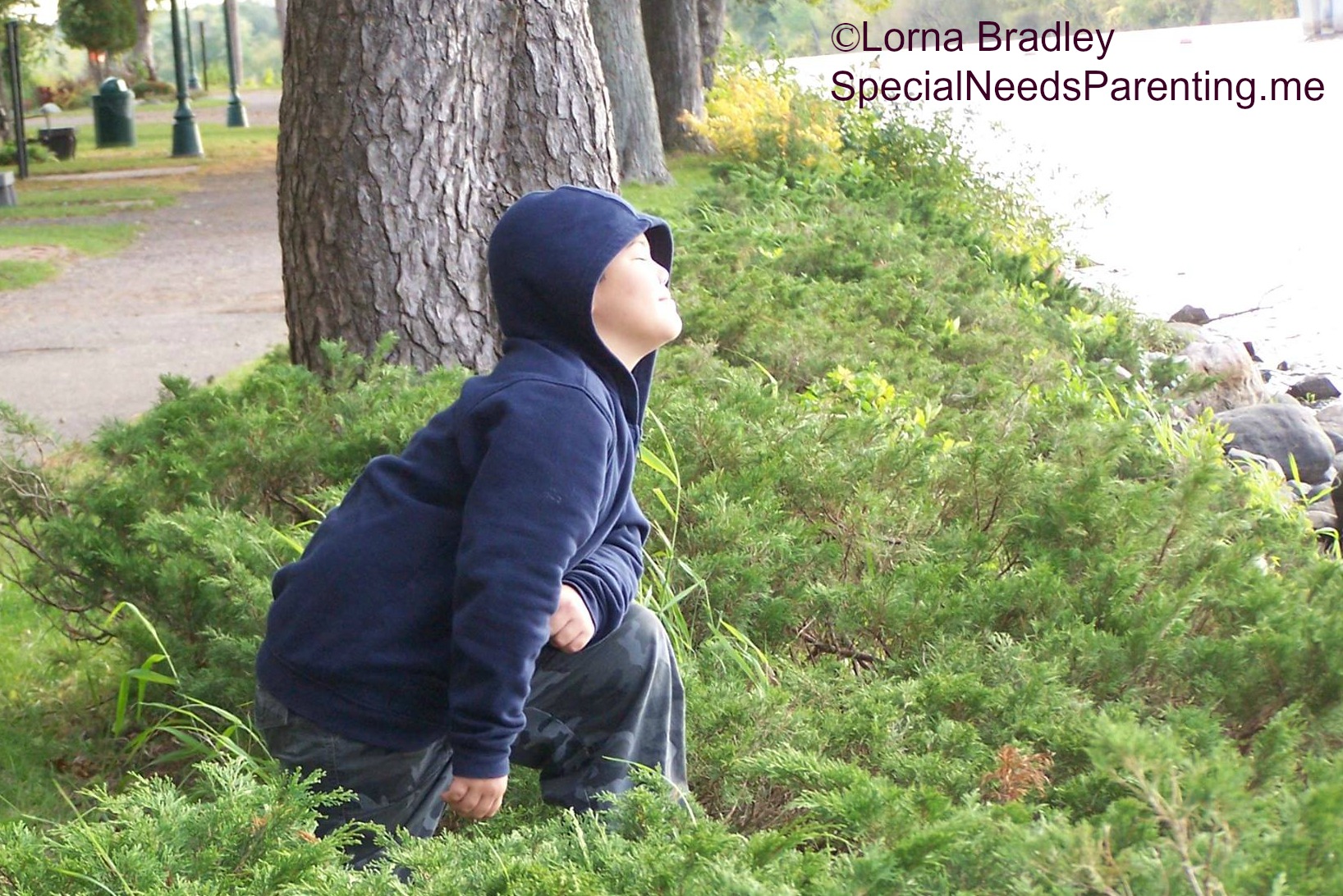
David as Luke Skywalker

                                             I will instruct you and teach you the way you should go;                                                     I will counsel you with my eye upon you. (Psalm 32:8 NRSV)

A few weeks ago I had a “quote of the day” that will not be topped for quite some time.

David (nine year-old boy): I’ve had the best year of my life.  Want to know why?

Me: Sure.  Why?

David: (Proudly) I didn’t throw up once!

David’s parents: (Shocked) David! There are things you don’t talk about at dinner!

Me: (Trying really hard not to laugh) Congratulations! Let’s hope this year is a repeat!

I had a most unusual experience a few weeks ago. Well, unusual for me. I spent the day with a typically developing child. Somehow I lost sight of the fact that typically developing children just aren’t part of my world. Being empty nesters, I’m not often around young children and when I am they usually have special needs.

I traveled to Minnesota for my ministry and mixed in a bit of fun by spending time with friends I’ve known for years. I also met in person for the first time their son David, a friendly, energetic and interesting boy.  He’s a Star Wars nerd like me so we hit it off right away. The photo above is his impression of Luke Skywalker gazing at the twin suns of Tattoine. It takes a fellow nerd to spot that pose for what it is! He greeted me with a gift, a quarter, and a thank you note for some cookies I baked and mailed to him years ago when he didn’t feel well.  He wasn’t tardy mailing it. I was tardy coming by for a visit to receive it.  He was keeping it to hand-deliver.  How sweet is that? I have his note and quarter sitting on my desk.

What I found so interesting is that throughout the day Roy and Darcy dealt with many of the same things we do as special needs parents. Social boundaries, rules, taking turns, all of it was woven into the pattern of the day. It was just plain old parenting, not the uber-steroid version of parenting so many of us experience.  I’m pretty sure no therapists, behaviorists, or compliance plans were involved.

We went to a botanical garden to enjoy the fall foliage and brisk north wind, a real treat for a Texan in October! It was a bit dull for David with no playground and plenty of signs warning, “Keep Off the Grass.” Following the rules, check. Carrying on a four way conversation, taking turns and figuring out how to jump in with something to say, check.  Practicing table manners, check. Sharing appropriate table conversations, check! Parenting is constantly teaching and redirecting, and my friends are great at it. I marveled at the energy Roy and Darcy had to keep up with David. I was impressed by the constant attention and consistent approach they brought to parenting.

As special needs parents we may feel a bit of envy at what appears to be an easier path for some. It seems to me that it ought to be simpler to parent a typical child. After my day with David I do not think that is necessarily true. Sure, there are things that we deal with that other parents don’t, such as therapy appointments, behavior plans, developmental limitations and medications. But parenting itself, the teaching and forming, the shaping of behaviors, is a lot of work. Being good parents has much to do with and the gifts and graces we share with our kids as we shepherd them toward adulthood. I thank my friends Roy and Darcy for reminding me that all parents share this same bond. It may have been a typical day for them, but it was a day of learning for me.

Loving Father, thank you for shaping us with love, leading and teaching us to live in ways that are pleasing to you. Help us to be for our children the parents that you call us to be, formed in your image. Forgive us for the times when we fall short as parents and help us learn to forgive ourselves when we make mistakes. May we grow in your grace as we grow in our roles as moms and dads. Amen.

Photo by Roy Mayeda

Confusion About Inclusion

Help And Care For Disabled Person by Teerapun

People were bringing little children to him in order that he might touch them; and the disciples spoke sternly to them. But when Jesus saw this, he was indignant and said to them, “Let the little children come to me; do not stop them; for it is to such as these that the kingdom of God belongs. (Mark 10:13-14 NRSV)

I wish Jesus had been more specific in his command, “Let the little children come to me.” For some reason it seems to cause a lot of confusion.

That’s right. There is confusion about inclusion.

For some, inclusion means there is a space and activity offered that is appropriate to a particular person’s needs.  For others, inclusion means being in the same room with everyone else doing what they are doing alongside them. The way that individual participates may be different from everyone else, but they are still part of the bigger group.  To my way of thinking, those are both examples of inclusion.  It all depends on the perspective of the individual.

Inclusion is whatever feels welcoming and comfortable to the person who wishes to be included. For some, that means having  a separate space and activities geared to their unique needs.  For others it means jumping in with everyone else and feeling welcomed to do so. If they don’t feel welcome and wanted, then it isn’t inclusive.

Surprisingly, folks can be rather divided on this topic, which I find puzzling. Thinking of my own experiences raising a child with special needs there were times when what others decided was inclusive didn’t feel at all inclusive to us. My son is greatly bothered by loud noise due to life on the autism spectrum. His time in student ministry when they gathered and listened to loud praise music for fifteen minutes prior to breaking into small groups was stimulatory torture.  In his case, being inclusive by saying “just come be part of the group, you are welcome to join us,” didn’t work.  From his perspective, it was like a weekly invitation to listen to fingernails on a chalkboard.  It also triggered obsessive thoughts about hearing damage that were only relieved by taking him for hearing screening. Following the example of Jesus each Sunday morning he went away to a quiet place alone, though in his case it had more to do with sanity than piety. He was welcome as part of the group, but he couldn’t tolerate being there. It really didn’t feel very welcoming despite good intentions. This was a great group of folks. I know they meant well, but…

Wouldn’t it have been nice for him to have company when he left the gathering? Wouldn’t it have been nice to have an alternate activity planned for him and others who share the same spectrum? Wouldn’t it have been nice to have a “non-loud” Sunday every once in a while so that everyone could be welcome as part of the larger group?  Any of those things would have felt much more inclusive and welcoming.

The best way to know what feels inclusive to those we wish to include in the church is to have a conversation and ask them. Then actually takes steps to make the needed modifications so that everyone feels welcomed and included.

This week Key Ministry is hosting Inclusion Fusion. It’s a chance to learn more from leaders in special needs ministry about how to offer inclusive ministries.  Check out this link to get the schedule of free webinars and to register:  www.inclusionfusion.tv. I’m looking forward to this opportunity to get fresh ideas and connect with others who love kids like ours.

Holy God, help us to hear those who ask for change and truly make a place for everyone. Amen.

“Help and Care for Diasbled Person”  Image courtesy of Teerapun at FreeDigitalPhotos.net

Thirty Days of Thanksgiving

ID-10087368

Thanksgiving is my favorite holiday. What do I love about it?  It’s a holiday without a big fuss. Okay, there is a meal, but I enjoy cooking and the day really isn’t about the turkey and whether or not it’s dry. What I like is that Thanksgiving doesn’t come with expectations. If I drop a card in the mail to a friend or give a small gift to someone I am thankful for, in the month of November that is just a thoughtful gesture. Come December, the bar gets raised substantially on that whole card-sending, gift-giving thing.

Thanksgiving Day itself is about simply sharing a good meal with family and friends. It brings back childhood memories of a houseful of people at grandma’s, sleeping in sleeping bags on the floor with my cousins, putting pitted black olives from the relish tray on my fingers like little puppets and savoring the salty brine as I ate them one by one.

Mainly, Thanksgiving is about thanking God for an abundance of blessings. Thanksgiving is simple and beautiful from start to finish when I focus is on what is important.

One day of thanksgiving isn’t nearly enough. For the past several years I have celebrated Thirty Days of Thanksgiving and write down every day in the month of November something for which I am thankful . Time and again I come back to my son. I am thankful for milestones that I thought would never come.  I am thankful for the sense of acceptance for the milestones that will never be. I am thankful for a sense of hope in a future that is yet to be revealed. I am thankful to be a parent to a remarkable young man who inspires me every day.

I am also thankful for other parents on the journey with me who encouraged me when I was unsure and who allow me to encourage them when they need it too. Years ago the Apostle Paul wrote to a dearly loved church in Philippi. This small group of followers encouraged each other and lifted each other up when they needed it. Paul opens his letter to them:

I thank my God every time I remember you, constantly praying with joy in every one of my prayers for all of you (Philippians 1:3-4 NRSV).

These were Paul’s people, the ones who had his back when times were hard, and the ones he encouraged and guided when they needed it too. These were Paul’s people and special needs parents are my people.

My thanksgiving today, and every day, is for parents who raise remarkable children and for the communities that surround them with unconditional love and support.

God of many blessings, I thank you for parents who are strong and parents in need of strength. I thank you for those who have wisdom and those who seek it. I thank you for those filled with hope and those who struggle. Woven together, parents strengthen each other. I thank you for the gift of community. Amen.

Image “Thank You on Post It Note” courtesy of Stuart Miles at FreeDigitalPhotos.net

Pick Anthony!

Hand Reach To Sky by samuiblue

The reason we never sit in the front row of a show is the inevitable request to the audience, “I’m looking for a volunteer.”

The reaction of virtually everyone was the same… Look away… Don’t make eye contact… Sit completely still and don’t appear that you can be separated from the herd…

Everyone except Anthony.  Anthony’s hand shot in the air with all the enthusiasm of Arnold Horshak on a re-run of Welcome Back Kotter. “Oh! Oh! Oh!”

I was sitting up in the balcony well out of the “accidental volunteer zone,” and it seemed everyone around me knew Anthony.

“Look at Anthony.”

“Anthony wants to volunteer.”

“I don’t think the juggler sees Anthony.”

Thus began the cheer from the cheap seats.  “Pick Anthony! Pick Anthony!”

I never actually met Anthony, but I knew of Anthony almost immediately when my husband and I took a recent fall New England cruise. Whether it was our fellow dinner companions, casual conversations in the gym, or chatting with fellow passengers on tours, it seemed everyone knew Anthony.

“Have you met Anthony yet? “

“No.”

“Oh, you will!”

I’m sure there are many things Anthony can’t do.  Frankly, I don’t care about those things. There are plenty of things I can’t do either so that just makes us even. A young adult in his mid-twenties, he was gregarious, friendly and everyone who talked about him thought he was great and had a funny story to tell. He sat in the front row at every show, always starting a standing ovation and blowing kisses to the dancers. Anthony was a unifier. Anthony was a cheerleader. Anthony was everyone’s friend. Our tablemates hung out with Anthony a good bit since their cabin was close to his and I always enjoyed hearing the stories that started, “Guess what Anthony did today.”

I suppose one of the favorite things about my vacation was that I got to experience a place called acceptance. No one focused on what was different about Anthony, but rather what was great about him.  It reminds me of Paul’s letter to the church in Corinth where they played favorites and he reminded him that we are all in it together.

As it is, there are many members, yet one body. The eye cannot say to the hand, “I have no need of you,” nor again the head to the feet, “I have no need of you.” On the contrary, the members of the body that seem to be weaker are indispensable, and those members of the body that we think less honorable we clothe with greater honor, and our less respectable members are treated with greater respect; whereas our more respectable members do not need this. But God has so arranged the body, giving the greater honor to the inferior member, that there may be no dissension within the body, but the members may have the same care for one another.  If one member suffers, all suffer together with it; if one member is honored, all rejoice together with it. (1Corinthians 12:20-26 NRSV)

Paul reminds us how to get it right. Everyone belongs. Everyone has a gift to share. It was a pleasure to see that lived out among my fellow passengers. The trip would have been less without Anthony. I’m glad God picked us to be on his ship.

Holy God, thank you for Anthony and the way that you have gifted him. May all those who share his unique abilities find a place called acceptance. Amen.

Image courtesy of “Hand Reach to Sky” by samuiblue at FreeDigitalPhotos.net

Boundary-Breaking Worship, REALLY!!!

Parables_April_Landing

Then afterward I will pour out my spirit on all flesh; your sons and your daughters shall prophesy, your old men shall dream dreams, and your young men shall see visions.   (Joel 2:28 NRSV)

Knowing about something and experiencing it, seeing it for yourself, are two entirely different things. Hospitality and welcoming in worship are things we all know about.  Hopefully we’ve all experienced both. Sadly, as parents of children with special needs that hospitality is often lacking, so when we truly receive it we know how precious a gift it is.

I recently attended worship at Parables, one of the worship services offered at Wayzata Community Church. I knew about the service.  I read about it, watched a video, and talked at length with the founding pastor, Leslie Neugent. KNOWING about Parables and EXPERIENCING Parables were different matters entirely.  It was boundary-breaking, joy-filled worship with surprises and the in-breaking of God at every turn.  If you live anywhere near Wayzata, MN you must experience this worship for yourself.  Even if you don’t live near, it’s worth the trip!  I flew all the way from Texas and know without a doubt it will not be my only experience of Parables. If your church could use an infusion of radical hospitality to the special needs community in worship, go to Parables!

What’s so different about this service?  It is worship created for and led by people with special needs.  I wrote in my blog recently a prayer, “Please God, let something happen in worship today that isn’t printed in the bulletin.” That prayer was answered.  Big time! Picture a parade of whoever cares to participate processing down the aisle, singing, shaking tambourines, hand in hand with the pastor.  A young man with sensory issues held his hands over his ears even as he marched in joyously, and then decided to go sit on the chancel steps for the rest of the service.  A fine plan! It has the best view!  And really, why should it matter?  During a break in the action a young lady who was late to church gave the pastor a seemingly never-ending hug, marching onto the stage to do so. Again, why should it matter? A young man who was until very recently non-verbal went around the room during the time of greeting saying, “Hello. How are you?” When was the last time you got truly excited about being greeted in worship? It made me cry tears of joy. I was seated by a young man who is learning to say hello by shaking hands.  We shook hands about 10 times during worship, including when I got up to talk about my upcoming book for special needs parent support groups.  He gave me the cue so I stepped out of the pulpit to shake hands.  I can walk and talk at the same time.  Why should it matter that he wanted to shake hands right then?

I saw the hands and feet of Jesus at work in the participants.  They know each other’s strengths and where they need a little help.  A young lady with challenged mobility had several of her peers help her up the steps to the altar to serve Communion. That’s right. Not just to receive, but to serve.  A request from the pulpit for a volunteer to lead the Lord’s Prayer received a round of applause as a teen stepped up to lead.  When was the last time the Lord’s Prayer brought you to tears? The same was true for a young lady who did a wonderful job reading the scripture of John 4, Jesus meeting the Samaritan woman at the well. How often are people with differences celebrated in worship?  How often do they get to offer their gifts and let them shine?

There was a purity and innocence to worship.  Parents were at ease.  They knew their whole family was welcome.  No one was shushed. No one was made to sit if they didn’t want to. Noises? Who cares!  Again, why should it matter?  The sermon challenged me to think about hard things as a special needs parent. Where is the line between advocating for my child’s future and giving over to God and accepting? Yet, simultaneously the message was at a child’s level so there was learning for everyone in the room. It was the most genuine, unscripted, open-hearted worship I’ve experienced in a long time, and I go to church a lot so that is saying something!

I met a church member who retired from teaching a few years ago.  “I go to the big service too, but this is really my service. I see God here.”  Well, I did too and I want more. I wonder if my husband would agree to move from Texas to Minnesota…

Prayer: Boundary-breaking God, Open our eyes to see those who feel excluded, open our hands to reach out to them, open our hearts to form us to better be your people. Amen.

Photo courtesy of Parables: Red Fish Theology

To learn more about Parables worship, click here:

http://www.wayzatacommunitychurch.org/pages/page.asp?page_id=229208

You can order a “how-to” guide here:

http://www.uccresources.com/products/red-fish-theology-parables-a-how-to-guide-for-offering-a-radically-inclusive-worship-service-with-the-special-needs-community


Welcoming the Whole Family

Green Door Mat Image courtesy of Stoonn at FreeDigitalPhotos.net

Welcome one another, therefore, just as Christ has welcomed you, for the glory of God.(Romans 15:7 NRSV)

“There is this family that attends my church and they have a little boy with autism.  I can tell that mom and dad feel really frustrated during worship because he has a hard time sitting still.  We are a really small church, only fifty members. There are no other children there and it’s so nice to see this family in worship. How can we be welcoming to them and make them feel more comfortable?”

As a pastor who has done welcoming ministries for fifteen years, focusing in caring for special needs families in particular over the last five, this question was music to my ears.  I explained to the woman that children with autism are going to have a really hard time understanding social boundaries about sitting quietly.  I suggested that they could work with the parents to have an activity bag for the child at church with things of interest to him. It would be something special that he would enjoy having when he is at worship.  When it got to the “boring part” (i.e. The Message) that is not going to be of interest, the boy could leave the sanctuary with a two buddies who would could lead an alternate Bible activity geared toward his age and abilities. The buddies would be nurturing adults or teens in the child’s life and the parents could enjoy that rare gift called “sanctuary.” They could have the parent’s cell number and send mom or dad a text if there is a problem and they need help.

The congregation member was nodding all along and agreeing these were great ideas. But then she asked, “Well, who is going to do all that?”

“I believe you mentioned that you have 50 members at your church.”

Blank stare.

I let it hang there. Still just a blank stare.

“Well, I’ll just show the mom where the cry room is located. She’d probably prefer to leave.”

I think we have the answer about why this is a small church and there are no children.  Sorry. I don’t mean to be harsh, but welcoming families means you are excited they are there. Excited enough to make an effort to include them as part of your church family. Rather than deciding for them what they would prefer, ask them. Rather than leaving them floundering in worship and frustrated, help them.

How do we create a church environment that is welcoming?  It’s simple really.  How do we welcome guests in our homes?  When we know someone is coming for a visit we get ready ahead of time.  We prepare the house, find out what folks like to eat and drink, plan things our guests will enjoy doing. We greet them with eager anticipation, “I’m so glad you are here! I’ve been looking forward to seeing you.” Then we show love and hospitality for our guests by trying to make sure they have a good time.

Church isn’t any different. Welcoming takes an intentional effort to be ready for the ones who are coming.

  • Prepare the house. Back to basics time. Is the church building accessible?  Is there a wheelchair ramp? Elevator? Accessible restrooms? Can people get into the building and navigate the hallways easily? If your congregation wants families with young children to be part of the body of Christ, anticipate their needs and prepare for them.  Children of all ages get bored in worship. Activity bags with scripture lessons, crayons, magnetic erase sheets, pipe-cleaners, and other quiet activities are great ways to keep kids engaged in worship at their own level.  Children with special needs are no different.  They want something to do. Modify as appropriate for their particular developmental capabilities.
  • Prepare the congregation. Often children with special needs do not understand boundaries and they make noise. Church leadership needs to model that is okay. I recall one sermon in which a young man was becoming agitated. Though non-verbal, he was loud at times.  Heads were turning. The pastor saw the parents were distressed and said, “That’s okay Cameron. This passage gets me upset too. I feel you buddy. You aren’t bothering me.”  The whole room was put at ease. Years later I cannot recall the sermon at all (nor any other sermon preached years ago!), but I can recall the radical hospitality of offering grace for a bit of disruption.  The Holy Spirit on Pentecost was pretty disruptive too, with the tongues of fire and all that.  I think church services can use more disruption.  A fine prayer, “Please God, let something happen today that isn’t printed in the bulletin.”
  • Learn from your guests. Have conversations with the parents and ask them what their children like to do and what is appropriate for them. For some parents, inclusion means finding a way for their child to be in worship with them. Perhaps they would like to be partnered with a buddy in worship who will keep their child engaged so parents can be more fully present to the sermon, etc. For some families, what feels inclusive is having a place that is geared to their child’s particular needs and is apart from the sanctuary. Either way, intentional conversation and a volunteer to work with the family says to them, “We are glad you are here and want you to be comfortable.”
  • It takes heart. There are plenty of resources for developing comprehensive special need ministries. Books by Erik Carter and Amy Fenton Lee are great starting points for practical ideas to get a ministry up and running.  The main ingredient is heart. It takes people who love families and want to be offer a welcoming place for them.  That’s it.  If you care, they will come. The biggest stumbling block to starting special needs ministries is fear. Congregations can “what if” themselves into a corner, frozen by concern of not being ready for every single possibility that may come their way. Having a heart for welcoming wins out over fear every time. Families that come don’t expect everything to be perfect.  We understand plenty about “not perfect.” We live it every day. What we want is a congregation that cares that we have come to church and wants us to be there even though we don’t fit the mold of the typical family.

I’d love to hear from parents about what works for you and makes you feel welcome at church.  Please post in the comments about your favorite experiences.

Welcoming God, we thank you that you call each of us to be in relationship with you.  A times it is hard to find a place that understands and prepares for the unique needs of our families.  Yet we know that what you call us to do you also equip us to do.  Open the hearts and minds of yet more congregations about ways they can welcome everyone who comes to worship you.  Amen.

“Green Door Mat” Image courtesy of Stoonn at FreeDigitalPhotos.net

Magnolia Leaves and Good Neighbors

OLYMPUS DIGITAL CAMERA

For your name’s sake O Lord, pardon my guilt, for it is great. (Psalm 25:11 NRSV)

If I knew magnolias were so messy I probably would not have planted them.  We moved to Texas twenty years ago into a new construction neighborhood.  The front yard was put in by the builder, the barren back yard was a constant mud pit with the pounding thunderstorms virtually every afternoon.  Add a four year-old who saw no issue with red Texas clay and new carpet… we needed some landscaping, stat!

Living in the south for the first time I made a snap decision that we needed magnolias. I loved the movie Steel Magnolias, the strength of the women, the way they kept going in the worst of times, the way they could rely on each other. Magnolias are the trees of the south! Magnolias on the fence line would be perfect!  Right after we got the yard put in a neighbor down the street commented that her husband wouldn’t let her have magnolias, “They are so messy.”

Messy?

Thus began the guilt.

The leaves fall year round.  Really?  When they get stressed in the heat they REALLY fall.  Drought? They throw a pouty, hissy-fit of leaves all over the place paying no attention to which side of the fence whatsoever. On our lawn or in the neighbor’s pool, those trees don’t care.

But I sure did.

I could clean up after messy trees in my own back yard, but it’s not like I could hop the fence and toss our leaves back over to our side.  Well, not unless it was the dead of night with a waning moon. Don’t ask me how I know this.

After twenty years those trees are really big now, dropping trashcans full of leaves at a time. Guilt by the bagful. I sometimes contemplate baking cookies for the neighbors as a sign of repentance. Then I’d get busy and the cookies never quite make it to the oven. I have even felt guilty about that!

New neighbors moved in two years ago.  We met over the back fence one afternoon. I apologized profusely about our trees.  “Let me know if they are a problem or if you need branches trimmed back. I’m so sorry they’re so messy…”

A gracious smile stopped by tumble of word. “We love your trees.  They are beautiful. We wouldn’t have a bit of shade in the evening without them. Just look at all the blooms about to come.”

Blooms? What blooms?  The guilt for messing up their yard took away the beauty of the blooms.

Funny how guilt is so insidious, yet serves no purpose. We beat ourselves up for things that matter little to others. We withhold forgiveness for ourselves when others offer it freely.

Special needs parenting can come with a heaping plate of guilt for so many things. Guilt for birth differences, lack of access to therapy and medications, lack of time for family and friends, short-changing siblings who get a smaller share of everything, to name a few. Does any of that guilt serve a purpose? Does it help in anyway?  Or does it just make the load heavier?  Do you work through it to a place of forgiveness just to find a few days later that you’ve picked it back up again?

Our lives are messy, like those trees.  So what? We grow stronger through the years, blessing others in ways we do not even see. We too have beautiful blooms. Do we take the time to recognize them for ourselves?

Whatever guilt it is that you carry, God is bigger. God forgives, wiping clean the slate for a fresh start. Allow yourself to live into that gift by giving over to God your guilt and taking back a life free of self-condemnation.

My prayer for you today, enjoy the blooms!


Image: Magnolia Grandiflora Flower by Andrew Butko [GFDL 1.3 (www.gnu.org/licenses/fdl-1.3.html) or CC-BY-SA-3.0 (http://creativecommons.org/licenses/by-sa/3.0)%5D, via Wikimedia Commons

So Many Emotions, So Little Time

Cry Laugh Button By Stuart Miles

Recently I was talking with a friend who is a special needs parent.  She was maxed out on every level and needed to vent.  After discussing insurance, therapy, extended family, children, spouse and everything else that was driving her crazy (I’m pretty sure laundry and sock count was on the list), she paused.  I just waited.  Finally she took a deep breath, spent from her tirade of the many things she had been shouldering.  I asked one question.

“How are you doing with self-care?”

“Terrible!”  Then the tears.  They came and came, a cathartic release long overdue.

Emotional health is just as important as physical health.  I was asked recently, “What is emotional health?” Folks understand taking care of their bodies, or taking care of their spiritual life, but taking care of emotional well-being is the more mysterious part of this self-care trinity.

Emotional health is being mindful of your emotional state. What are you feeling? Why are you feeling it? All emotions are valid, but are you stuck too long in the more “negative” emotions such as anger, depression, or guilt? Taking time for self-care of your emotional health builds emotional reserves for times when life is extra challenging.  Barb Dittirch of SNAPPIN’ MINISTRIES refers to it as “Comfort in the midst of chaos.”

Jesus, being fully human and fully divine, experienced emotions. He was angry when he saw the way the temple was being desecrated by money-changers.  When he returned to Bethany after the death of Lazarus he was deeply troubled. Jesus was indignant when the disciples kept the children from coming to him.  Jesus was anxious on the night of his arrest, taking his disciples with him to pray, asking the Father to take the cup from him.

In his anguish he prayed more earnestly, and his sweat became like great drops of blood falling down on the ground. (Luke 22:44 NRSV)

Jesus models for us good emotional health by being in relationship with friends, taking time for himself in solitude to relieve stress, expressing emotions in a healthy way, and turning to God in prayer for strength.

So how can we nurture good emotional health? Here are a few tips:

  • Be mindful of your emotions. Especially notice emotions that dominate in ways that have a negative impact on you or your family: anger, depression, anxiety. Look for underlying causes when stuck in particular emotions.
  • All emotions are valid. Allow yourself to feel what you feel and acknowledge those feelings.
  • Nurture friendships. Set aside time to nurture the friendships that matter most to you. Having close friends who are worthy of trust can help process experiences that are challenging and celebrate joys.
  • Spend time in prayer. Talking with God is like talking with your closest friend who knows you better than you know yourself. Emotional healing and emotional health are helped through prayer.
  • Enjoy time with your child. Spend time just having fun with your child without a goal for development or therapy. Simply have fun together.
  • Pay attention to self-talk. Is your self-talk positive (Yes I can! I tried my best, etc.), or negative (Why do I bother? I’m the worst parent ever). Reshaping self- talk positively is a powerful tool in emotional health. Refute negative talk with, “That’s not true.” If it helps, say it out loud.
  • Set aside time for yourself. Take a break and relax when you can. Regularly do something you enjoy whether it’s going outside, reading or meeting a friend. Make it a priority to do what makes you happy at least for a little while each day.
  • Find ways to reduce stress. Do not take on more than you can handle. It is okay to say, “No.” It is also okay to say, “Yes.” (Do you need a break? Would you like some help? How about a night out?) If someone is offering help it is not a sign of weakness to accept it.
  • Engage in your favorite hobbies. Take time to enjoy the things that most inspire you, help you relax, or create contentment.
  • Practice gratitude. Every day say out loud something you are grateful for. Make it part of the family meal, with everyone sharing their thankfulness. Write them on a list and add to it every day.
  • Keep a journal. Writing can be highly effective in processing emotions.
  • Join a support group. It is helpful to talk with others who share your experiences, allowing you to talk openly and be heard.
  • Talk to a counselor. A trained professional is a valuable asset for emotional health.

Look over the list and find the ones that resonate with you.  Do you need more time with friends? Intentionally nurture those relationships.  Are you over-committed?  Take a thing or two off of your plate and feel the stress go down. Need a creative outlet?  Dig out that favorite hobby you haven’t done in ages and set aside an hour or two for yourself to unplug and enjoy.  Do you think you need talk with a professional?  Good for you for seeing that need.  Take the first step and make an appointment. Whatever appeals to you most, make it a priority to recharge your emotional batteries.

Check back next Wednesday for the final part of this blog series, spiritual self-care.

Healing God, We come to you with praise, sorrow, joy, worry, fear, with so many emotions. All of our emotions we lay at your feet knowing you love us and that you can heal the broken places in our hearts. Amen.


“Cry Laugh Buttons Shows Crying or Laughing” by Stuart Miles

Image courtesy of Stuart Miles at FreeDigitalPhotos.net