Tag Archives: special needs parenting

Planting a Spiritual Garden

To The Garden Sign With Pot by Simon Howden

A young mom raising three kids was going through a hot, dry Texas summer.  The garden was wilting, grass withering to dry, brown patches.  She moved the garden hose around back, filling a small wading pool for her kids to play in. She meant to reconnect the hose to the spigot out front where it belonged, but instead left it in a heap in the back yard. She’d get to it later when things weren’t so busy. There were so many other things that were more important.

One day she looked out the front window to see that the dry front lawn had caught fire, probably from a cigarette butt tossed out a car window.  She ran to the spigot she had forgotten. No hose!  She ran to the back yard, dragging the hose around.  It was a tangled mess, full of kinks and knots.  She ran back to get her children’s sand castle buckets abandoned by the wading pool.  Racing back and forth from the spigot to the front lawn, she tried to put out the fire, one child-sized bucketful at a time.

This is the kind of story Jesus used for teaching. It’s a parable.  The life-saving water is God.  The hose is our connection that comes through developing an intentional relationship with God. The fire is whatever crisis is waiting in the future.

Have you ever disconnected your hose? Left it in a tangled mess? I know I have at times. Life gets busy.  I mean to read scripture. I mean to schedule a prayer retreat. I mean to… well, a lot of things. Just like physical and emotional self-care from my earlier blogs, spiritual self-care takes intentional nurture.

Spiritual self-care is intentional focus of time and energy on your relationship with God. Richard Foster, author of Celebration of Discipline and a leading expert on spiritual self-care, offers the following suggestions as ways you can enrich your spiritual life.

  • Internal Disciplines. These disciplines focus on your spiritual life through internal reflection.
    • Prayer
    • Meditation
    • Study of scripture
    • Journaling
    • Silence/listening
    • Fasting – not only from food, but from distractions such as television.
  • Outward Disciplines. These disciplines are lived out in personal actions and outward expressions.
    • Solitude – set aside time to be apart from others to focus on God
    • Simplicity – embrace a practice of “enough” and let go of wanting more
    • Submission – follow where God leads
  • Corporate Disciplines. These disciplines are lived out with others
    • Worship – regularly participate in worship, including the sacraments
    • Service – being God’s hands and feet in the world in help to others
    • Community – engage as part of a Christian community where you can share your talents with others, as well as be supported

There are many additional options.  Look at this list and think about what already works for you. Celebrate those! Well done! Look for what interests you as something you would like to do and make a plan to try it.  For me, silence is a great discipline.  My life used to be filled with noise. The TV always on, or the radio, some distraction constantly in the background. One year for Lent I gave up those distractions. I took a fast from noise and found the gift of silence.  I liked it so much that I didn’t turn on the radio in my car for a decade. When I decide to watch TV I need a quick lesson from my son or husband about how to use the remotes (why do we have to have so many and why do they need so many buttons?)

Solitude is also a great discipline for me. I’m an extravert. I love being around people, but at times I crave being alone.  Right now I have the house to myself for four days, a rare gift. I will be total hermit. Just me and the cat, writing away on my book and blogs, thinking of scripture and seeking connections that offer hope to parents. Even in my solitude I found space for another discipline, worship.  I joined Key Ministry Front Door Online worship.  I was blessed by the message and connection with others for an hour, but now I return to my gift of solitude and prayer for parents.

Where I work there is a serenity prayer garden.  It has five flowing fountains and a labyrinth gravel path that winds its way through an arbor of wisteria. I try to spend at least a few minutes there each day. On a glass water wall there is this hymn:

I come to the garden alone while the dew is still on the roses, and the voice I hear falling on my ear,  the Son of God discloses.

And he walks with me, and he talks with me, and he tells me I am his own;  and the joy we share as we tary there, none other has ever known.

My prayer for you is that you find what nurtures your spiritual garden and be filled with the peace of Christ. Amen.

“To The Garden Sign With Pot” from FreeDigitalPhotos.net

So Many Emotions, So Little Time

Cry Laugh Button By Stuart Miles

Recently I was talking with a friend who is a special needs parent.  She was maxed out on every level and needed to vent.  After discussing insurance, therapy, extended family, children, spouse and everything else that was driving her crazy (I’m pretty sure laundry and sock count was on the list), she paused.  I just waited.  Finally she took a deep breath, spent from her tirade of the many things she had been shouldering.  I asked one question.

“How are you doing with self-care?”

“Terrible!”  Then the tears.  They came and came, a cathartic release long overdue.

Emotional health is just as important as physical health.  I was asked recently, “What is emotional health?” Folks understand taking care of their bodies, or taking care of their spiritual life, but taking care of emotional well-being is the more mysterious part of this self-care trinity.

Emotional health is being mindful of your emotional state. What are you feeling? Why are you feeling it? All emotions are valid, but are you stuck too long in the more “negative” emotions such as anger, depression, or guilt? Taking time for self-care of your emotional health builds emotional reserves for times when life is extra challenging.  Barb Dittirch of SNAPPIN’ MINISTRIES refers to it as “Comfort in the midst of chaos.”

Jesus, being fully human and fully divine, experienced emotions. He was angry when he saw the way the temple was being desecrated by money-changers.  When he returned to Bethany after the death of Lazarus he was deeply troubled. Jesus was indignant when the disciples kept the children from coming to him.  Jesus was anxious on the night of his arrest, taking his disciples with him to pray, asking the Father to take the cup from him.

In his anguish he prayed more earnestly, and his sweat became like great drops of blood falling down on the ground. (Luke 22:44 NRSV)

Jesus models for us good emotional health by being in relationship with friends, taking time for himself in solitude to relieve stress, expressing emotions in a healthy way, and turning to God in prayer for strength.

So how can we nurture good emotional health? Here are a few tips:

  • Be mindful of your emotions. Especially notice emotions that dominate in ways that have a negative impact on you or your family: anger, depression, anxiety. Look for underlying causes when stuck in particular emotions.
  • All emotions are valid. Allow yourself to feel what you feel and acknowledge those feelings.
  • Nurture friendships. Set aside time to nurture the friendships that matter most to you. Having close friends who are worthy of trust can help process experiences that are challenging and celebrate joys.
  • Spend time in prayer. Talking with God is like talking with your closest friend who knows you better than you know yourself. Emotional healing and emotional health are helped through prayer.
  • Enjoy time with your child. Spend time just having fun with your child without a goal for development or therapy. Simply have fun together.
  • Pay attention to self-talk. Is your self-talk positive (Yes I can! I tried my best, etc.), or negative (Why do I bother? I’m the worst parent ever). Reshaping self- talk positively is a powerful tool in emotional health. Refute negative talk with, “That’s not true.” If it helps, say it out loud.
  • Set aside time for yourself. Take a break and relax when you can. Regularly do something you enjoy whether it’s going outside, reading or meeting a friend. Make it a priority to do what makes you happy at least for a little while each day.
  • Find ways to reduce stress. Do not take on more than you can handle. It is okay to say, “No.” It is also okay to say, “Yes.” (Do you need a break? Would you like some help? How about a night out?) If someone is offering help it is not a sign of weakness to accept it.
  • Engage in your favorite hobbies. Take time to enjoy the things that most inspire you, help you relax, or create contentment.
  • Practice gratitude. Every day say out loud something you are grateful for. Make it part of the family meal, with everyone sharing their thankfulness. Write them on a list and add to it every day.
  • Keep a journal. Writing can be highly effective in processing emotions.
  • Join a support group. It is helpful to talk with others who share your experiences, allowing you to talk openly and be heard.
  • Talk to a counselor. A trained professional is a valuable asset for emotional health.

Look over the list and find the ones that resonate with you.  Do you need more time with friends? Intentionally nurture those relationships.  Are you over-committed?  Take a thing or two off of your plate and feel the stress go down. Need a creative outlet?  Dig out that favorite hobby you haven’t done in ages and set aside an hour or two for yourself to unplug and enjoy.  Do you think you need talk with a professional?  Good for you for seeing that need.  Take the first step and make an appointment. Whatever appeals to you most, make it a priority to recharge your emotional batteries.

Check back next Wednesday for the final part of this blog series, spiritual self-care.

Healing God, We come to you with praise, sorrow, joy, worry, fear, with so many emotions. All of our emotions we lay at your feet knowing you love us and that you can heal the broken places in our hearts. Amen.


“Cry Laugh Buttons Shows Crying or Laughing” by Stuart Miles

Image courtesy of Stuart Miles at FreeDigitalPhotos.net

Caring for God’s Holy Temple

Young Woman Relaxing At Mountain View by Feelart

My lungs were burning, longing to take a breath, but I couldn’t.  I was taking part of in exercise in a room full of people and we were told to hold our breath, so hold it I would.  I started seeing little dots!

At recent retreat spiritual director Cindy Serio of MOSAIC Ministry had us sit quietly and practice a deep breathing exercise she learned from Joyce Rupp.  We began breathing at the rhythm that she dictated. Breathing in and holding, breathing out and holding.  She led us into longer and deeper breaths with longer periods of time in between. At first the exercise was soothing, but as the pauses between breaths got longer and longer, I began to grow uncomfortable.  As a runner, I have pretty good lung capacity, but I found it challenging to exhale and keep my lungs empty for as long as she required.  As the pauses grew ever more exaggerated my oxygen-starved body grew very uncomfortable. Try as I might, I just needed air. I chalked it up to a recent round of the flu and pneumonia, so I cheated and inhaled just a little. Who would know? Then I had to do it again. I marveled at Cindy’s lung capacity and felt like a failure as we finished the activity.  Afterwards, Cindy asked who needed to breathe in before she prompted us.  Everyone in the room raised their hand. Cindy said, “Good. You each showed compassion to yourself. It is hard to offer compassion to others when you cannot offer it to yourself.”

Isn’t it interesting that I felt like a failure for needing air?  Air!  A basic bodily need and I denied it to myself simply to keep up with everyone else. Taking care of our bodies is one of the most basic of needs we have and yet all too often we shove it to the back burner.  There is just too much going on in our lives.  Maybe when things are less hectic… Consider Paul’s words to the church in Corinth.

Do you not know that your body is a temple of the Holy Spirit within you, which you have from God, and that you are not your own? For you were bought with a price; therefore glorify God in your body. (1Co 6:19-20 NRS)

We glorify God when we take care of ourselves!  When I look it that way, taking time to care for my physical well-being isn’t an indulgence. It’s a gift to God.  I can’t keep up with the pace God sets for me in ministry if I am sick and run down.

So what are some basic ways to care for our bodies?  Below I have a brief list of options.  Look it over and note down the ones you already do, the ones you would like to start, and the ones in which you have no interest.  The goal here is not to make you feel guilty. Rather the goal here is to find where your interests are and focus your energy there:

  • Get adequate sleep
    • I will go to bed 30 minutes earlier than usual three nights this week
    • I will schedule one sleep-in day once a week
    • I will take a nap or lie down while my child naps
    • I will remove distractions from the bedroom (TV, iPads, laptops, pets, etc.)
  • Eat a balanced diet
    • I will keep a healthy snack in my car, purse, desk, etc.
    • I will read an article on nutrition and make one change in my diet
    • I will drink less soda
    • I will try a new food
    • I will reduce caffeine intake
  • Drink plenty of water
    • I will grab a travel cup of water every time I head out the door to run errands
    • I will try a caffeine free tea or mineral water (no sugar, no caffeine)
  • Exercise
    • I will walk one mile three times this week
    • I will sign up for a class (yoga, pilates, walking or running group, Crossfit, etc.)
    • I will do some stretching on weeknight evenings before I go to bed
    • I will sign up to run/walk the local Turkey Trot on Thanksgiving morning and then train to do it between now and then
    • I will do 25 sit ups every day
  • Take time to relax
    • I will soak in a hot bath for 20 minutes after the kids are in bed
    • I will put my feet up and read a magazine
    • I will sit outside and enjoy the sounds of nature when I need a break
    • I will lie down and rest for 10 minutes
  • Seek Medical Help as Needed
    • I will get an annual flu shot
    • I will see the dentist
    • I will get an annual physical
    • I will get a mammogram
    • I will see a doctor as needed

These are just a few suggestions.  I’m sure you can think of others that are the right fit for you.  Looking over the list, the ones that you marked that you already do, give yourself a pat on the back for doing those.  Look over the list of ones in which you have no interest.  Perhaps consider those for another time, but if they aren’t a fit for you don’t beat yourself up about it.  Now look at the list that are things you would like to do.  Pick one and make an intentional plan for the week.  Write it down and post where you will see it as a reminder. Maybe this week you will choose to walk a mile three days of the week. Perhaps next week you will choose to schedule a sleep in day.  Whatever it is that appeals to you, make an intentional plan each week to do something that takes care of your physical well-being. Learn to take care of God’s holy temple by building it up with one brick at a time. You’ll be stronger for the journey ahead.

Check back next Wednesday for the next part of this wellness series, emotional self-care.

Holy God, what a gift it is that you live inside of each of us, filling us with your strength and peace.  Help us find the time and energy to care for our bodies which are wonderfully made by you. Let our bodies be your temple, your holy dwelling place giving honor to you. Amen.

Young Woman Relaxing At Mountain View

Image courtesy of Feelart at FreeDigitalPhotos.net

Take Time to Take Care

Alarm Clock

As special needs parents it is so easy to put ourselves at the bottom of the priority list. We give for our children, our spouses, our friends, our jobs, our churches, our schools.  There are so many needs and they are so pressing and urgent.  At times it can be a struggle to be enough. Compassion, like any muscle that is over-used, can tire and be stretched too far.  Compassion fatigue is the inability to continue to offer care at the level previously provided.  It is hard to continually offer compassion to others when we do not even offer it to ourselves.  When you reach the point where you cannot see your way to the bottom of your to do list, does self- talk criticize that you can’t do it all? Do you drive yourself to dig in and do yet more?  Self-compassion is the recognition of your own need for help, nurture and respite.

I think as Christians some may feel they are called to give selflessly and endlessly, but the Bible models for us self-compassion and self-care even in the midst of caring for others. In Matthew 14, John the Baptist was beheaded by King Herod, “Now when Jesus heard this, he withdrew from there in a boat to a deserted place by himself. But when the crowds heard it, they followed him on foot from the towns. When he went ashore, he saw a great crowd; and he had compassion for them and cured their sick” (Mat 14:13-14 NRS). Jesus tried to set aside time for himself, perhaps to mourn the death of his cousin, perhaps to move farther from the reach of Herod, perhaps to avoid crowds drawing attention to him. But the people have heard where he is going and they race there ahead of him.  His opportunity for respite turned into an opportunity for compassion and healing. When the evening came there was no food.  His disciples urged him to send the crowds away so they could get food in the local villages.  Instead, Jesus multiplied the five loaves of bread and the two fish and fed them all.

So where does the self-compassion and self-care come in?  Isn’t this an example of self-care gone wrong with life interrupting and taking away the chance for respite? Here is the rest of the story, “Immediately he made the disciples get into the boat and go on ahead to the other side, while he dismissed the crowds. And after he had dismissed the crowds, he went up the mountain by himself to pray” (Matthew 14:22-23 NRS). Though Jesus’ plan for respite was interrupted, by the end of the day he made time for it.  He took care of the pressing needs of the crowd and the disciples and then sent them both away so that he could be alone to pray. Was this to recharge spiritually?  Did he rest while alone to recharge physically?  Did he grieve for John during his time of prayer, processing emotions of loss?  Scripture does not tell us. What we do know is that Jesus offered to himself the same compassion he offered to others.  Being both human and divine, he knew his human limit and made self-care a priority, even in the midst of tremendous pressure. It may be easy to think the needs of our families are just too much for us to take a break, but could the needs of our families really compare to the needs and expectations laid on Jesus?

Taking time to take care of ourselves doesn’t mean we are weak, selfish or incapable.  It means we are human and the same need for compassion that we see in others is a need that we have too. Over the next few weeks I will post a short series with practical ideas for physical, emotional and spiritual self-care that can fit even into the busiest schedule. I hope that it will be a blessing to you so please check back next Wednesday.

“Ringing Alarm Clock” image courtesy of Paul at FreeDigitalPhotos.net

Just the Right Teacher

Back to School

We have gifts that differ according to the grace given to us: prophecy, in proportion to faith; ministry, in ministering; the teacher, in teaching … (Romans 12:6-7 NRS)

Meet-the-teacher night is always exciting, nerve-wracking, and hope-filled. Thinking back to when my son was young, at the start of a new school year, I would get anxious butterflies thinking about whether or not a teacher would “get” my son.  His behaviors could be challenging. He took up a lot of extra time due to his learning differences.  I would try to fill the gap a bit for his teachers each year by taking things off their plate where I could.  I figured teaching my son ought to come with some perks. I volunteered to help in the workroom, moving my teacher’s requests to the top the pile and doing them first. Every month I’d leave a small appreciation gift in their mailbox just to let them know how much it meant to me that they were helping my son learn despite his challenges.  A small packet of home-baked cookies, a giant chocolate bar, a gift card to a coffee shop or movie theater were just simple ways of saying thanks. My gifts were so small in comparison to the gifts they gave to Craig.

Teaching children is not a gift I have.  You know how some folks can walk into a room, snap the lights off and on and everyone gets quiet and pays attention?  When I try that I have five kids racing to the light switch, “Let me do it!” Math facts? Forget it! Oh I know them.  I just can’t teach them without someone ending up in tears. Often it’s me! Teaching truly is a gift and some have it and some don’t.  Since I don’t, I really appreciate those who do.

One of the greatest gifts I ever received came from my son’s helping teacher in first grade.  She had a great heart for special needs and could see past diagnosis to my son as a child of God, loving what she saw there. Toward the end of first grade we were talking after school one day when I picked up Craig. She was hoping for a child of her own, which was not coming as easily as it does for some.  She told me that she wished she had a boy just like mine.  I commented something about raising a boy is a lot of fun.  She said, “No. You aren’t hearing me.” Choking back tears, “I want a boy exactly like him. He’s amazing!” It was a healing balm for a hurting mother’s heart to know this woman who spent all day every day with my child was undaunted by behaviors and learning differences. Of all the kids she knew and helped she wanted one just like mine. In a way, her acceptance helped me with my acceptance.  I always accepted my child, but autism? It takes a while to make peace with that.  Having just the right teacher taught me a thing or two.

Prayer: Teaching God, We thank you for those who have the gift of teaching. They bless our families in powerful ways. Each child has a teacher who can unlock their abilities.  We pray your blessings on them as they prepare for a new school year. Amen.

Photo: Back to School by nuttakit from FreeDigitalPhotos.net

Just One Friend Part 2

Calhan_Colorado_High_School_Cafeteria_by_David_Shankbone

Some friends play at friendship but a true friend sticks closer than one’s nearest kin. (Proverbs 18:24 NRSV)

Everyone wants and needs relationships. We are hard-wired for it. One of the biggest hurts I have felt as a parent is wanting my child to feel accepted and connected to others. In the support groups I lead it is a common issue that resurfaces again and again. I talk to parents about nurturing the relationships they do have and they switch to talking about relationships their children don’t have. I have been mulling around an idea that has not really taken shape yet, but it goes something like this. Wouldn’t it be great if churches could host a “Just One Friend” night. Invite the special needs community and anyone else who is looking for friendships. Set up games and activities. Parents stay and help foster connections. This in’t a respite night. It’s a relationship building night. Kids build relationships with kids.  Parents build relationships with each other. The general premise is that folks are coming to have fun and meet new people that they may want to connect with after game night is over. That’s kind of a bare bones snap shot, but I think it could be a way churches could offer important relief from isolation, which is a big part of healing on the journey with special needs.

Here are a couple of practical strategies I used for nurturing friendships when my son was younger. I recognize that this is not a universal list for all the various differences amongst our children. Hopefully it will at least provide some fertile ground for other ideas to spring up as well:

  • Remind your child that everyone will be looking to meet new people. They are not alone in that feeling of being in a class with new people.
  • Have your child talk to kids who are friendly and suggest they ask them questions. Kids love to talk about what they did over the summer. Be an interested listener.
  • Have them look for others who look lonely and talk to them. My son can spot a kid on autism spectrum in heartbeat. Like matches with like sometimes.  They get him in a way others don’t.
  • Have them make friends with grownups at school. The cafeteria monitor can be a great ally in finding friends and avoiding bullying.
  • Dress like everyone else. This sounds basic, but it is amazing what an impact it can have if a child is “over-dressed” for school, especially boys. If they look like they came from a fashion shoot for children’s resort wear change their clothes!
  • If you feed them they will come. If Craig had a friend over in elementary school (not an everyday occurrence!) I’d ask his guest what was his or her favorite cookie and then bake them while the kids played. Over the years Craig’s friends started calling our house Craig’s Pub. As teens, I started calling them the herd that comes to graze. BTW – 5 grazers coming for a half day video game birthday bonanza this weekend. (Number of gamers times number of pizza slices I think they want plus an extra two per person because they are boys divided by the number of slices in a large pizza…) Prayers appreciated that I don’t get trampled in the kitchen!
  • In keeping with the above strategy, drop by once or twice a month to the school cafeteria with a couple of pizzas or one of those giant cookie cakes. Some folks grab a slice and run. Others grab a slice and stay.
  • If you typically pack a treat in your child’s lunch, pack two so that they have an extra to share.
  • Invite others. Waiting around for a playdate invitation that doesn’t come feels lousy. Make the effort to extend yourself. Sometimes there will be rejection, but other times you get a winner.
  • Be intentional about fostering relationships. Even small acts of kindness are nurturing.

What are some friendship strategies that have worked in your household? Please comment and share ideas.  You never know what may help another parent spark a friendship.

Prayer: Loving God, We are wonderfully made to be in connection with others.  Please help those connections to grow among our children. Calm nervous feelings about meeting new people and open pathways for meaningful relationships to flourish. Amen.

Photo: “Calahan Colorado High School Cafeteria” by David Shankbone

Just One Friend Part 1

Calhan_Colorado_High_School_Cafeteria_by_David_Shankbone

Some friends play at friendship but a true friend sticks closer than one’s nearest kin. (Proverbs 18:24 NRSV)

Didn’t summer just start last week or the week before?  Yet there they are. Ads in the paper for back-to-school supplies. My Facebook feed is full of friends caught up in back-to-school preparations. Friends who are teachers are posting pics as they fit in one more vacation before the new school year.

As a special needs parent, back-to-school comes with an oddly mixed sensation of anxiety and hope. I am always hopeful for a new year and new possibilities.  It’s the “what if” gremlins that make me anxious. With a little experience I finally figured out the first day of school routine.  I pray my son out the door with a positive, “God’s got you, so you’ve got this!” and keep the anxiety part to myself as I sit by the phone and wait for the call from the school office.  Autism and the first day of school. The call was inevitable at my house. I learned just to go with it.

My biggest prayer for my son each year is to make one friend. Just one. One good friend will see you through anything. Barnabas traveled with Paul on long and dangerous journeys to share the gospel.  Moses had Aaron on his journey to and from Egypt. David had Jonathan through battles and political intrigue. Of course my dreams were more sedate. I simply prayed for a person to sit with my son in the cafeteria and maybe hangout to build Lego castles and help save the world in the latest video saga. 

Looking back over the years that prayer has been answered each year. Some of those kids my son connected with in elementary school are still friends after high school. Some are neuro-typical.  Others are not. In the long run those differences matter little between real friends. The truth is that sometimes friendships bloom out of the most unlikely connections if well-nurtured, though I did give Craig one piece of advice that really helped.  Look for the kid who is by himself at lunch and go join him.  I bet he would like to have just one friend too.

Check back tomorrow for my post with practical strategies for helping our kids make friends.

Prayer: Loving God, Watch over our children as they look for friends.  Create pathways for connections where they feel loved and accepted.  Amen.

Photo: “Calahan Colorado High School Cafeteria” by David Shankbone

Just Horsing Around

Steeplechase_(2018245)

If I had known the day was going to include a life or death, headlong, downhill race after my son, I would have worn different shoes.  In hindsight, I should have seen it coming.

We moved to Chicago from Alaska while my husband attended graduate school. Living on a tight, student’s budget, we were happy to find a family friendly event in the neighboring town of Naperville, an annual steeplechase.  It was a day in the country with horses jumping over fences (be still my heart!), gorgeous fall foliage, and a hillside picnic where our high-energy, high-rise dwelling three year old with ASD could enjoy the great outdoors and fire his afterburners. Perfect! Thinking it might be a fancy horse event, I wore casual slacks and flats.  That was mistake number one. Oh, I was dressed just like everyone else, but…

We parked in the freshly mown hayfield and climbed the hill to find the ideal place for Craig to run and play, spreading out our blanket with the perfect view of the finish line. Opening our picnic hamper, we settled in for the first race. Eight brush jumps, a beginner round taken at an easy pace.  Craig watched the horses jump the first few fences, bouncing away in my lap on his imaginary horsey, and shouted, “My turn!”

I thought he was joking.

That was mistake number two.

Back in the day in Alaska I rode horses and my husband would meet me at the barn with our son.  After I had finished my ride, we’d buckle on a helmet and Craig would sit in the saddle in front of me, kicking his tiny feet, “Go Alex, go!”  Each time he got to the barn, he’d see me jump a fence or two, call out, “my turn!” and he’d get a ride.

You know how kids with ASD are about routine?  Well, I hadn’t figure that out yet.

He jumped out of my lap and started running down the hill, “My turn!  My turn!”

I called after him that he couldn’t ride those horses, thinking he would stop. Ya, right. All I managed to do was let him get a head start.

That was mistake number three. Game on!

Mommy instincts finally kicked in.  He’s not stopping!  His tiny legs had remarkable turnover as he sprinted for the finish line.  “Craig! Stop! The horses are coming!”

“My turn!”

Dear God help me! No one else knew what was happening. The rest of the sparse crowd had their attention fixed on the finish line. I started running faster, flats slipping on the damp grass.  My husband, realizing the seriousness, was on his feet behind me.  There was no time to zigzag around the other picnicking guests.  I leapt entire families in hurdler form, screaming like a crazy woman, “Craig! Stop!”

“My turn!”

All dignity gone, feet skidding wildly, I finally managed to scoop up Craig about ten yards from the rail. Frankly, I was glad I didn’t fall on him and crush him.

Relieved. Scared. Embarrassed. Elated.

I tucked him under my arm like a wiggly football, full of giggles for his great adventure,  and started the long trudge back up the hill to scattered, polite applause, apologizing to far more people than I care to remember. I was embarrassed, they were amused.

I realized in that moment how deeply I loved my child.  I couldn’t think of logical consequences for a punishment, nor behavior plans. I doubt in that moment I even knew my own name, but I felt an overwhelming sense of love and knew nothing would keep me from chasing after him.

Perhaps that was for me a dim glimpse into the love that Paul writes of in his letter to the Romans.

For I am convinced that neither death, nor life, nor angels, nor rulers, nor things present, nor things to come, nor powers, nor height, nor depth, nor anything else in all creation, will be able to separate us from the love of God in Christ Jesus our Lord. (Romans 8:38-39 NRSV)

Absolutely nothing separates us from the love of God. God loves us in a deep and abiding sense. God, too, pursues us when we are headed the wrong way, flinging wide protective arms, even when we chose not to see them. When we finally turn to Him, He embraces us. “Welcome home, little one! I’m glad you’ve stopped horsing around.”

Photo by Jason Trommetter “Steeplechase” via Wikimedia Commons

Thank you Sandra Peoples for inviting me to guest blog today wiht this post at  specialneedsparenting.net.  If any parents out there are looking for a great book to use for parent support resources, check out Sandra’s book “Held.”

A Place Where Everybody is Welcome!


Coco

God saw everything that he had made, and indeed, it was very good. And there was evening and there was morning, the sixth day. Thus the heavens and the earth were finished, and all their multitude. (Gen 1:31-2:1 NRSV)

A sign I have lived in Texas for a long time: Yesterday my husband came home from work and found me relaxing on the back patio. “My car says it’s 95 degrees!  Aren’t you hot?” I was sure he was wrong.  It felt lovely! I checked the temperature on a weather app.  96 degrees.  Well, he was wrong…

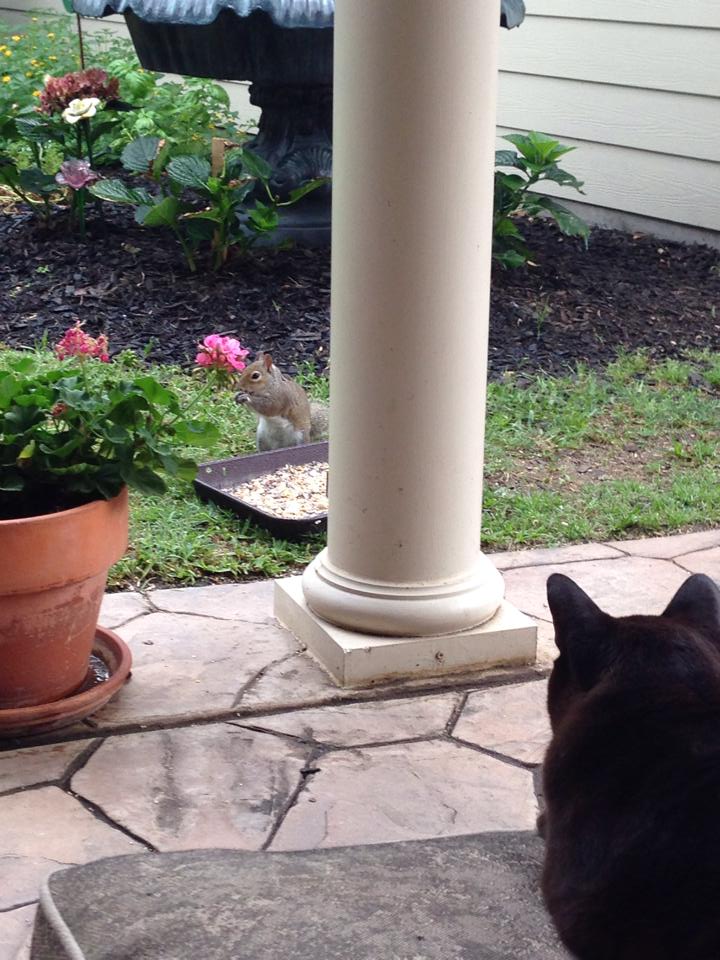
Being around creation recharges my batteries. I simply have to get outside and enjoy the beauty of what God made.  A perfect respite for me is time with my cat Coco, my furry and feathered friends who come to my backyard feeder, and a splashing fountain to provide just the right background music. Bliss!

God made it all and called it good.

We have a highly inclusive bird feeder, which doubles as a squirrel feeder.  I keep it on the ground for more convenience to me and the squirrel. We take everybody who comes and everybody gets what they want.  I think about their needs. Blue Jays? More peanuts! Cardinals? More safflower and sunflower seeds! Mockingbirds? Sliced apples and fresh berries hit the pan.  Our garden is planted to attract bees, butterflies and hummingbirds.  Water, food, shade.  My yard is haven for all and I make sure it is inviting and inclusive to everyone.

Years ago I watched a man feeding doves. He only liked a certain variety.  When ones showed up he didn’t like he shooed them away, kicking sand toward them.  I wonder to this day what he had against those particular birds. Why weren’t welcome?  Granted, they were not as cute, not as agile, not as delicate as the ones he favored, but they were special in their own way. Besides, God made them all and called them good.

Inclusion means making a place for everyone, welcoming whoever comes.  Jesus said, “Let the children come to me.”  He didn’t kick sand at the ones who weren’t “cute and agile.” He made space for them.  All of them. It’s no coincidence that many of the stories of Jesus were about people with special needs. Those were his people. Jesus was inclusive.

All means all.

This past June I met a pastor who leads a worship service where truly “all means all.” Leslie Neugent at Wayzata Community Church in Wayzata, Minnesota thinks outside the box about how to do inclusive worship.  Her service, Parables, is led by and for families with special needs, attracting over 100 worshipers on a typical Sunday. How do they attract so many?  The key is the right invitation.  I don’t mean one they print and hand out, though they likely do that too. I mean Leslie and her team are intentional about thinking about what families need.  A safe place where noises are allowed? Not a problem! A child who wants to be in the center of the action? Fantastic!  The more volunteers the better! Pattern and predictability work best for your family? You got it!  Familiar songs, short sermons, lots of activity for all levels. Check out more Parables worship here for ideas to share with your church: http://www.wayzatacommunitychurch.org/pages/page.asp?page_id=229208

Attraction and inclusion come through thinking about who we care to welcome and then providing a welcoming environment, whether it is a backyard or a church.  God made us all and calls us good, too. I am so grateful to serve our God of inclusion.

Photo: Backyard Friends by Lorna Bradley

May God Bless You and Keep You

Time For Family

Peer pressure, bullying, and simply trying to fit in can lead any child to make wrong choices.  When you add to the mix our kids who can struggle socially due to their differences, the desire to be part of the crowd (or just have one friend – PLEASE!) can pull our kids in directions we certainly would not choose. How do we raise kids who are grounded? At a recent lunch and learn event, Rabbi Ranon Teller of Brith Shalom Congregation talked about Jewish traditions and how they are effective in raising young people who are grounded.  He had my undivided attention. He pointed to three pillars that are part of Shabbat (Sabbath): ritual, Sabbath rest and blessing.

Ritual

On Shabbat, the family gathers for a meal Friday night beginning at sun down.  In this tradition, all family members are present and seated at the table together enjoying a meal without interruptions. No excuses accepted for other things that need attention. A key piece is simply the ritual, the intention and practice of making it a priority to be together. In this, the family disconnects from the outside world and reconnects with each other.  Studies show that over time American families eat together less and less. Conversely, families that do eat together are more resilient and have improved communication between members.  A healthy body happens with intentional regular action. We can say we want to have a healthy body and that it is important to us, but for that ideal to become a reality we need to develop regular practices of healthy eating and exercise.  A healthy body comes through regularly repeated activities. And so it goes for the health of the family. Building family closeness and connection requires regular practices as well, such as the ritual of a gathered meal and time that is set aside just for the family. (Family game night, anyone? Pizza and a movie? Build the best ice cream sundae contest?)

Sabbath

Sabbath is the practice is disconnecting from the business and work of everyday life and setting aside a time of rest.  In the Jewish tradition, part of that rest includes disconnection from technology.  (I hear wailing and gnashing of teeth. Some of that noise is coming from me!)Engaging with technology draws focus and energy away from those gathered together.  Rabbi Teller told of families placing technological devices in a basket and intentionally setting them aside. Disconnecting from iPads, gaming devices, and cell phones encourages deeper connection within the family. I tried it and it really works. On a recent date night my husband and I did something we had not done in years. We left our phones at home. On purpose!

Blessing

In the Jewish tradition of Shabbat, parents bless their children in prayer, often with the priestly benediction:

May God bless you and keep you.

May God shine light and be gracious to you.

May God show you kindness and grant you peace. (Numbers 6:24-26 NRSV)


Showering your child with the gift of regular prayer and blessing teaches them of God’s love, as well as your love, for them. Also, the power of prayer is an amazing thing in the life of a child.  Never under-estimate what God does through prayer.  Prayer itself can become a ritual.  I used to pray with my son every day before he got on the bus to go to school. It was just a brief prayer about asking God to protect him, bless him and give him the ability to handle the day.  Several years into this tradition I started attending seminary.  As I was leaving that first night for class my son came bounding down the stairs and said I could not leave yet because we had not prayed.  He offered a blessing to me, a simple prayer that left me blessed in more ways than one.

What are your family rituals?  Are there ones you would like to start?  How do you take a Sabbath rest and disconnect from the demands of the world?  When and how do you bless your child and family?


“Time for Family” Image courtesy of Stuart Miles / FreeDigitalPhotos.net