One Motivation

Special Needs Parenting Cover

There is one motivation behind my ministry at Hope and Healing Institute.  That’s it.  Just one. Equipping families with special needs to remain resilient. That happens through providing tools and support to individuals facing any number of challenges that come with parenting a child with special needs. Mine is just one of many support programs offered here in fulfilling our mission of building and restoring lives to health and wholeness. I am blessed to be part of this amazing non-profit that is changing lives for the better.

After writing Special Needs Parenting: From Coping to Thriving, the Hope and Healing Institute equipped me to pilot the material with five small groups. I led three of them in the Houston area, another online,  and another was led by Rev. Leslie Neugent at Wayzata Community Church in Minnesota. Leslie and I both experienced a sense of community, friendship and healing within our groups.

The most rewarding part? Hearing from people about how their lives have been enriched and changed for the better in the process. Mimi Patman, a participant in one of the groups that I led, shares insight into her parenting experience.From the shock of diagnosis to the power of hope found in scripture and community, Mimi opens a window into her private family life in hopes that it will encourage others as well through this brief video.

My prayer is that other parents looking for emotional and spiritual nurture will also be blessed through the book and that an increasing number of faith communities will offer support groups and pastoral care to families wishing to be included within the life of the congregation.

Rev Doc Lorna

Anger: The Elephant in the Room

On June 9 I shared the article below at Not Alone Parenting.  You can find the original post here: http://specialneedsparenting.net/anger-the-elephant-in-the-room/

CastingoutMoneyChangers

 “Each morning when I would drop off my neuro-typical daughter at pre-school I found I felt so angry. Every single day I was irritable for no reason.  It made no sense. I loved her school.”

“I’ve been in such a bad mood lately and I don’t know why. I get annoyed with traffic, with standing in line, with everything really. I was even mad that the weather was cold the other day when I was on carpool duty at school.”

“When I hear other parents talking about their vacation plans it just irritates me. I wish they would keep their “perfect world” to themselves.”

These three experiences of anger are just a few of many that have been shared by special needs parents in interviews and support groups I’ve led over the years.  It’s an uncomfortable topic for many, and so it not often discussed.  Anger and resentment can be the elephant in the room of the special needs parenting experience. Yet, like all emotions, these feelings are valid and need reflection and healthy expression in order to be processed.

I brilliantly decided one year for Lent to give up feelings of anger and impatience. It seemed to me more “Christian” at the time.  It did not go well. Pretending that I didn’t feel something didn’t make it go away, rather it came out in unexpected ways similar to the stories above.

There is a popular phrase making the rounds on social media.

If anyone ever asks you, “What would Jesus do?” Remind them that flipping over tables and chasing people with a whip is within the realm of possibilities.”

Humorous, and a good reminder that anger is a valid emotion. Jesus acted on his anger in an unjust situation:

Then they came to Jerusalem. And he entered the temple and began to drive out those who were selling and those who were buying in the temple, and he overturned the tables of the money changers and the seats of those who sold doves; and he would not allow anyone to carry anything through the temple. He was teaching and saying, “Is it not written, ‘My house shall be called a house of prayer for all the nations’? But you have made it a den of robbers.” (Mark 11:15-17 NRS)

Why was Jesus angry? People who came to the temple needed to offer sacrifices.  For some who had traveled great distances it was easier to purchase a sacrifice at the temple rather than bring one from home. Roman coins of the day had images of the emperor who claimed he was divine.  Jews wishing to give money as tribute at the temple needed to change their coins for currency appropriate to be given at the temple.  The moneychangers made a nice profit in the exchange, as did those selling animals for sacrifice.  The temple and its courtyard dominated a large portion of the city.  It was a long walk to go around it, especially if carrying something heavy from one side of the city to the other. It became a custom for some to take a shortcut through the courtyard rather than go around. All of these things were disrespectful to the holiest place in the land. Jesus clearly knew why he was angry and he directed his anger toward the appropriate source, albeit in a way that was disruptive and shocking. Then again, much of what Jesus did was disruptive and shocking, including walking out of a tomb.

For special needs parents, finding the source of anger can be more challenging. The reason isn’t always obvious. When a sense of irritation shadows every step of the day, it is worthwhile dig through to the root cause. Anger can sometimes be a mask disguising other more deeply held feelings of embarrassment, insecurity, vulnerability, or pain.

For the first parent I mentioned above, she found she was processing resentment about how easy it was to drop off her youngest child relative to how challenging it was to deal with a van and a wheelchair with her oldest. Suddenly experiencing “easy” made her realize anew that many parts of her everyday life were difficult.  The second parent found she was resentful of how restricted her time was. She was over-scheduled and every delay proved an annoyance, including cold weather that made the carpool line extra-long. The third parent realized she felt lonely and excluded, rather than “sour grapes” jealousy as it seemed at first. Once each parent took the time to dig more deeply into the cause of their anger they found they could resolve it effectively, targeting the true source.

There is a simple yet effective strategy to help dig to the bottom for the source of anger.

  • Is your anger illogical or disproportional to its source? As with the parents above, it made no sense to be irritated at the cold weather or during preschool drop off.  Anger that is illogical or disproportional deserves some deeper reflection to get to the real root cause.
  • Take time to reflect on the “what” and “why.” It may take digging through layers of “why” to get to the underlying answer. With the second parent above, that process went like this: What is making me angry? Everything! Traffic, lines, just everything! Why does that make me angry? I’m in a hurry and I don’t have time to waste. Why am I always in a hurry? I have too much to do. Why do I have too much to do? I need help and I don’t ask for it. Why? I feel I need to do everything myself.
  • Once the “why” is uncovered, is there something that can change to address final “why?” For the third parent, her why was that she felt lonely and excluded. Anger was her mask for these other more vulnerable feelings. She was able to address feeling lonely and excluded by intentionally making time to nurture relationships with friends and family. Once she felt more supported and secure in her relationships, seeing others enjoying their relationships no longer upset her.

While anger is a valid emotion and deserves appropriate expression, truly understanding the source is the key to finding resolution and forgiveness of self and others.

Healing God, we thank you for all of our emotions, even anger which shows us when something is wrong. Help us to understand and express anger in healthy ways. Lead us toward peace and reconciliation within ourselves and with those around us. Amen

Rev Doc Lorna

Carl Heinrich Bloch [Public domain], via Wikimedia Commons

Navigating the Mine Field of, “Don’t!”

https://i0.wp.com/upload.wikimedia.org/wikipedia/commons/8/8c/Jacob_van_Oost_%28II%29_-_Christ_and_the_Samaritan_Woman_at_the_Well.jpg

I try to be sensitive to the differences and needs of others.  Truly I do!  Yet it is seemingly so easy to say or do the wrong thing.  As I read various articles pretty much daily about how best to be in ministry with my community, it feels as though I am constantly told, “Don’t.”  Is it just me?

  • Five Things You Should Never Say
  • Four Things People Need to Stop Doing
  • Ten Assumptions that are Plain Wrong!

I get the point.  These article create awareness and help break bad habits that are sometimes hurtful to others.  I would like to think after exposure to the barrage of directions I could get it right.  Truthfully, it just makes me anxious that I will cause offense because of their negative perspectives.  Sure enough, the very thing I try not to do, I do.

I was helping out at the registration area for a recent conference and was asked to take on the task of escorting people from the housing area, to the dining area, to the conference center and back again.  Simple enough.  I made my way through the lobby inviting folks to come and see where we would be meeting the next day.

A man called to me as I went by, “Where is everyone going?”

I called back, “I’m taking folks on a tour of the campus. Would you like to come and see it?”

There was a pause.  I turned to look, checking if he had heard me. That’s when I noticed I was addressing a person with a visual impairment.  And I’d just invited him to “come and see.” Every “don’t” list I’d ever read overwhelmed me with instant embarrassment.

He just laughed, “I’d love to see it!”

His graciousness stopped me from becoming a blundering fool of tangled, backtracking words. No offense was intended. He knew that. Thankfully none was taken.

I know I’m not alone in the anxiety of “don’t.” A colleague this past week called me feeling “mortified” by something she had said, worried it had caused offense. Again, it was clear none was intended and none was taken! When we experience a world other than our own, there is a steep learning curve. It’s best to let others guide us positively rather than treading on the eggshells of “don’t.”

I once carefully guided a person with visual impairment through a complex series of stairs, connecting rooms and elevators, always trying explain what I thought she needed to know: changes in flooring, impediments, and elevation.  Her request at the end of the journey? It had nothing to do with safety. “Tell me about the room we are in. I like the way it sounds.”

“We are in a very traditional chapel with massive stone walls held up by high, beautifully carved arches.  There are stained glass windows all along the sides and the light pouring in from the windows at the west has painted the room in a kaleidoscope of colors. The swaying tree branches outside create movement in a tapestry of light dancing on the walls.  The altar in the front is a heavy mahogany piece with an embroidered white altar cloth that reads, ‘Do this in remembrance of me.’ Communion elements are waiting for us there.”

“I see it now.  Thank you.”

In helping her see the room, I saw it myself for the first time and truly appreciated where I was. After the service, our journey back to where we started had an entirely different dialogue.

I think at times the long lists of “don’ts” keep people from connecting in meaningful ways. Twice in the Gospel of John Jesus’ disciples invite others to “Come and see.”  Nathanael is skeptical of what he can learn from Jesus based on where Jesus is from:

Philip found Nathanael and said to him, “We have found him about whom Moses in the law and also the prophets wrote, Jesus son of Joseph from Nazareth.” Nathanael said to him, “Can anything good come out of Nazareth?” Philip said to him, “Come and see.” (John 1:45-46 NRS)

After a long talk next to a well in the hot afternoon sun a Samaritan woman abandoned her water jug and ran to invite the very people who ostracized her, “Come and see a man who told me everything I have ever done! He cannot be the Messiah, can he?” (John 4:29 NRS)

Both Nathanael and the woman at the well had to get past a list of “don’ts” to talk with Jesus.  Nathaneal assumed there was nothing he could learn from someone from a tiny, backwoods town. The woman at the well fought cultural biases about interactions between men and women, Jews and Samaritans.

Just as these two people of the Bible discovered, we lose out when we give too much power to the word “don’t.”  It is so much more enlightening to accept the invitation to step into the world of another and be blessed by the opportunity to “come and see.”

Living God, Help us encounter each other with open hearts and learn from others who are far better guides than we can ever be. Amen

Rev Doc Lorna

Photo: Jacob van Oost (II) [Public domain], via Wikimedia Commons
Strong and Able-bodied?

“Weak Or Strong Directions” by Stuart Miles from FreeDigitalPhotos.net

With flood waters rising in my hometown of Houston, the need for help was inevitable.  For a colleague in ministry, many homes in her neighborhood flooded and help was needed urgently from her church. The social media plea asked for a “good number of folks who are strong and able-bodied” to assist.

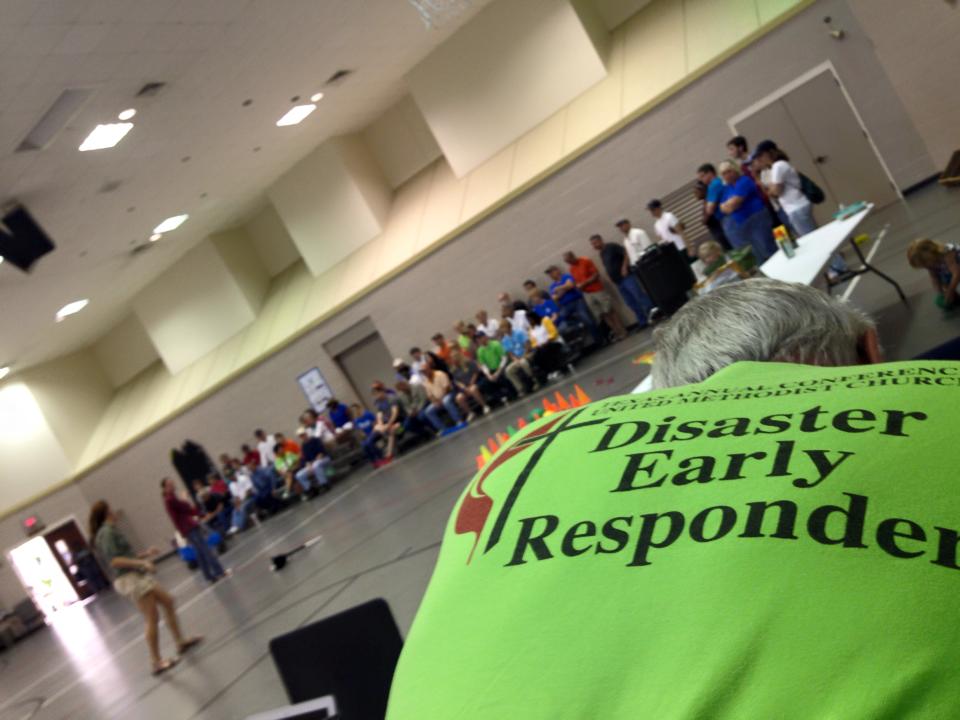
Disaster Early Response

When I read the request I was out of town at a conference, the Summer Institute on Theology and Disability, with people from all around the world. I looked around the conference center and wondered, who is strong? Who is able-bodied? Who decides?

I’m strong enough, but temporarily not able-bodied due to an over-zealous workout that badly strained several tendons in my ankle and left me hobbling with mincing steps. I’d slowed my steps earlier in the week for friends with wheelchairs and canes. On that day, I struggled to keep up with them. Our conference host introduced to the concept of “no wasted movements” to help my days run more smoothly. One presenter spoke of people being “temporarily able-bodied.” So true! Whatever our capacity is on any given day it is likely to change, perhaps in an instant.

I looked across the room at a person in a manual wheelchair. I’d seen her push herself down long carpeted hallways. Which of us is stronger? I sure wouldn’t want to arm-wrestle her! I looked at another friend in a motorized wheelchair whose words I struggle to understand. She is very patient, letting me respond with what I catch and then filling in the rest until I have it right. She has a brilliant theological mind and writes poignantly about God and faith. She is remarkably able-bodied in some ways, less so in others.

As the psalmist writes, “I praise you, for I am fearfully and wonderfully made” (Psalms 139:14 NRS). We are all strong and able-bodied. We simply express it in a broad variety of ways. I am not criticizing the wording in in my friend’s message of outreach for neighbors in need. She and her church have done a remarkable job in ministry! Rather, I’m suggesting each of us look at ourselves and our own families and celebrate how each person is strong and able-bodied. Celebrate the ways in which each is gifted.

Paul wrote to a divided church in Corinth:

As it is, there are many members, yet one body. The eye cannot say to the hand, “I have no need of you,” nor again the head to the feet, “I have no need of you.” On the contrary, the members of the body that seem to be weaker are indispensable.  (1Corinthians 12:20-22a NRS)

A young mother of two children was struggling with the early effects of multiple sclerosis when her church put out a call for volunteers to help build a home for Habitat for Humanity. Sitting on the sidelines was not an option for this young mom, but neither was lifting drywall nor swinging a hammer. Their contribution? Sack lunches with a prayer of encouragement tucked inside, beverages, and home-baked treats. The family celebrates the house they helped build each time the drive by.

In choosing for ourselves to share with others the ways in which we are strong and able-bodied, everybody wins.

Gracious God, we thank you that we are fearfully and wonderfully made. The true strength humanity comes in its diversity, a kaleidoscope of gifts and graces that celebrate your glory. Amen

Rev Doc Lorna

Photos: “Weak or Strong” by Stuart Miles from FreeDigitalPhotos.net  “UMC Early Responders” by Hannah Terry

Cords That Cannot Be Broken

 Strand by TCJ2020 from FreeDigitalPhotos.net

“I tried to connect with another parent raising a child with special needs, but she compared her child to mine. She said I can’t understand what she goes through. My situation isn’t as challenging as hers because my child ‘just has …’.”

Q&A time after a presentation is always interesting, but this recent statement… Wow!  I spoke at a Mother’s retreat and this mom’s comment caught me by surprise in some ways, but also resonated in others.

I’ve led support groups for years and find parents connect on a variety of levels.  Though their journeys and diagnoses of special needs may be very different, parents have a variety of common experiences: grief and guilt, anxiety about the future, coping with school plans, and more. As parents bond and connect, they can see past the differences in diagnoses to their shared challenges in parenting.   Time and again I’ve heard parents marvel at how connected they feel despite the fact that the diagnosis within their families are so varied.

Yet I have also heard comments like the one the mom shared at the retreat.  My son is on the autism spectrum and when he was entering high school another parent of a child with autism told me that I didn’t know what it was like for her because my son was older then and didn’t have the same expression of autism as hers. True, on some levels. Though my son was not born “older,” one can never know the exact experience of another person.    There is a saying, “If you’ve met one person with autism, you have met one person with autism.” It is a spectrum with a variety of expressions as unique and individual as fingerprints.  But it doesn’t mean that the differences in the expression of that spectrum renders parents incapable of hearing each other’s stories and helping each other in the midst of hard times. If we limit ourselves to only connecting with parents on exactly the same path as our own, it is going to be a very small circle of understanding and support.

It is possible to care and connect even if our life circumstances are different.  We do that all of the time.  Recently we’ve experienced torrential rain in my hometown.  I’ve received phone calls, text messages, and social media connections from across the country from friends checking in to see if my family is okay.  I suppose I could respond by saying, “If you’ve not had multiple inches of rain in a short period of time day after day you can be no help to me.” The truth is that you don’t have to experience a flood of epic proportion in your home town to be able to understand that it is frightening, creating rising anxiety to match the rising waters.

Genuine empathy and compassion are not necessarily born of having lived the exact circumstance, rather they are born of caring and friendship. One of the healthiest things parents can do for themselves is to connect with others in mutually supportive relationships.  In the book of Ecclesiastes, the author writes poignantly of the importance of relationships.

And though one might prevail against another, two will withstand one.  A threefold cord is not quickly broken. Ecclesiastes 4:12 NRSV

Sure, we can stand against adversity and challenges on our own, but it is so much easier to share the journey. Community and support are a gift, even when they come from unexpected places.

Holy God, bind us together, Lord, bind us together with cords that cannot be broken. Bind us together, Lord, bind us together with love. Amen

Rev Doc Lorna

Prayer by Bob Gillman

Image “Strand” by TCJ2020 from FreeDigitalPhotos.net

The Unforgettable Gift

“Knowledge Concept” by Supertrooper from FreeDigitalPhotos.net

O God, you are my God, I seek you, my soul thirsts for you; my flesh faints for you, as in a dry and weary land where there is no water. So I have looked upon you in the sanctuary, beholding your power and glory. Because your steadfast love is better than life, my lips will praise you. (Psalms 63:1-3 NRS)

I was not raised in the church, yet I found God drew me toward the church throughout my life.  It remained for me a place of holy mystery and peace, a place with answers, and a place with people who had something that I needed in my life too. The church was a beacon, drawing me to find what I was missing.

That can pose a challenge when you show up on Sunday with a child with differences.

When we moved to Texas twenty years ago the church we attended was growing quickly.  There were tons of children, but no special needs ministry. Frankly, I was not even aware that a special needs ministry was something  my family needed.  I just knew that we had a child with way too much energy, a child with behavioral challenges, a child who frustrated easily and needed order and structure. I felt overwhelmed at times, looking for answers that remained elusive.

I needed sanctuary in the true sense of the word. I needed a holy dwelling place and a place of refuge. I needed respite and spiritual nurture.

I received all of those week after week, attending the worship service that corresponded with children’s Sunday school. Our son had activities and lessons suited to his age, attention and energy. My husband and I received the spiritual nurture that we craved. The service we attended was the smallest one.  Most other adults went to Sunday school at the same time as their children and then attended worship as a family. There was no way our energetic wiggle worm could hold it together for two hours. Maybe someday, but not then.

No one ever complained about our son and his challenges. At the end of the school year I found out why as the Sunday school teachers prepared the students for “promotion Sunday” to the next grade level.

I was in conversation with one of his teachers, Kathy. “I’ve so enjoyed being with your son this year.  He is such a charming boy and so curious about everything. I’m going to miss him when he moves up a grade, but it will be nice getting back to my own Sunday school class.”

A few more questions revealed the whole story.  Kathy normally volunteered one Sunday a month with the preschool children, maybe a bit extra if a substitute was needed. She gave up her own time with her Sunday school class of ten years to be with our son. She never said a word about it, she just did it because she sensed that was what our family needed.

“He’s a child that does better working one on one with the same person each week. He likes consistency. Sometimes we take a break and go out in the hall where it is quiet. He likes that better than the busy classroom.”

Kathy was the one who offered the gift of sanctuary to me and my family. She gave me the opportunity to be formed spiritually while in worship. She also gave me a true example of Christian caring.

The discernment process within churches creating and equipping special needs ministries often include many steps: prayer, task force formation, focus groups and surveys, recruiting and training volunteers, and more. All doable. All necessary in the long run.  However, we find the true heart of special needs ministry in people like Kathy who are welcoming, who focus on what a child can do rather than what they can’t do, and who use their gifts and graces in a way that brings glory to God and creates disciples by example. In this season of teacher appreciation, I am especially grateful to Kathy and her unforgettable gift.

Nurturing God, Thank you for Kathy and all the teachers who nurture and welcome and make a place for all of your children. Amen

Rev Doc Lorna

Image: “Knowledge Concept” by Supertrooper from FreeDigitalPhotos.net

Five Ways to Support a Parent in Medical Crisis

“Counting Hand Sign” by Teerapun courtesy of FreeDigitalPhotos.net

A friend loves at all times, and kinsfolk are born to share adversity. (Proverbs 17:17 NRS)

Parents of children with frequent health crises and hospitalizations can easily become socially isolated. Family, friends and congregations often would like to help, but may not know what parents need. Parents may not even know themselves what would be helpful. Here are a few basic suggestions for offering support:

  • Parents often enjoy company. Compassion fatigue can be a real challenge for families. Even though hospitalizations may be a frequent reality, each one is due to a critical medical need placing parents under tremendous stress.  Parents spend countless hours on edge and in need of distraction. A friendly face at the door can be a real blessing. Contact them first to let them know you would like to stop by if they want some company and ask what time is best for them.
  • Offer to help, and be specific. I catch myself at times saying, “Let me know if you need anything.”  I mean what I say, but the offer is so vague that it almost never accepted.  It is better to be specific and ask if there is something in particular they need, or make an offer that is clear. “I’d like to bring a meal on Monday or Wednesday,” or “I can pick up your youngest child from school and bring her to my house for a play day,” or “I will be running errands all day Friday and would be happy to pick up your groceries or other things you need while I’m out.” Also, offer your prayers and be specific.  Ask parents how you can pray for them that day. The medical situation may be constantly changing with new concerns each day.
  • Check in regularly. A phone call or text message letting parents know you are thinking of them is helpful. Or if a parent is inundated with too many contacts (far too often this is NOT the case), offer to be a liaison sharing information with others, coordinating meals, transportation and other needs.
  • Hospital stays are expensive. Apart from medical costs and deductibles, paying for parking and meals adds up quickly. A gift basket with snacks, gift cards to local restaurants, or even a Visa gift card help defray some of those expenses. Many congregations have a hospital parking fund to which members can donate and then pastors pass the funds on to families as needed. If your church does have one of these, look into what you can do to help start one.
  • Families under stress need respite. A parent may be unwilling to leave a bedside unless another adult is constantly with their child. Once the child is home again, the effects of the stressful situation often remain. Parents need an opportunity for a break. Offering to stay with a child gives couples and single parents a chance to get away. If parents prefer to tag-team, with one staying home, moms and dads appreciate an invitation for a girls or guys night out. Even a few hours away with a good friend is a real blessing.

These are just a few ways in which families need support. The best way to know what is most helpful is to ask. Please feel free to share other suggestions in the comments.

Loving God, thank you for those who walk along side us when we need help the most. Guide us to return the favor in a way that is pleasing to you. Amen

“Counting Hand Sign” by Teerapun courtesy of FreeDigitalPhotos.net

Rev Doc Lorna

There Are Plenty of Things More Painful than a Root Canal

“Discourage Or Encourage Keys” by Stuart Miles

Therefore encourage one another and build up each other, as indeed you are doing. (1Thessalonians 5:11 NRS)

Honestly, a root canal is no big deal. I had one 13 years ago, and then had it retreated on an emergency basis last week when that one failed.  All I experienced was relief, though there was one moment of great discomfort…

The doctor and his assistant kept a running conversation while I was in the chair, involving me at times with questions that could be answered by grunts and shrugs.

The assistant told of her two year-old daughter and her precocious language skills.  “We were at my son’s soccer game this weekend and my daughter was talking away.  She was talking in sentences early and has progressed to whole paragraphs. There was a dad near us who commented on what a good talker she is.  He pointed to his son, ‘This one is three and hasn’t said a thing.’ Then he hit the boy on the side of the head.”

It wasn’t long after that the doctor noticed a tear in the corner in my eye, “Are we hurting you?”

Yes, but not in the way you think.

My heart still aches for the young boy with a speech delay and a parent who is a bully. Is he receiving early intervention for his delay? I doubt it.  I could be jumping to conclusions, but reading between the lines I see a parent’s ego tied up in his child’s abilities. When those abilities don’t match his standards – whack! That “playful” whack was painful enough.  I hope that he does not also receive ones that are harder when others aren’t around to see.

It is normal for a parent to feel grief for a child with differences, and part of the grief process is denial. Denial can be helpful in some ways.  It guards us from what we cannot yet process and accept.  We are, however, not meant to dwell in the land of denial forever. It can be harmful to ourselves and those around us.

Maybe if that parent moved out of denial and into acceptance the conversation would have ended like this, “Your daughter is so inspiring.  My son is working hard to get some words. He has a great therapist. I know it will happen for him someday.” In my mind’s eye there is a hug in there too.

While finding the courage to face a diagnosis can be painful, it opens the door to become an encourager. A person who encourages also empowers. The Apostle Paul set an impressive example in encouraging.  Paul writes again and again to his churches, offering to “strengthen and encourage” them. Variations on the word “encourage” appear thirty times within Paul’s letters and the story of his ministry in Acts. He wrote to people being persecuted.  He wrote to people who mourned the loss of loved ones.  He wrote to people trying to follow the spirit of the Jesus’ teachings, but getting it wrong at times. If needed, Paul would admonish and correct, but he always followed up with encouragement. He went back to his churches and visited in person, or sent his friends, so that others wouldn’t feel alone in their struggles.

In part because of encouragement offered to the early followers, a rag tag band of persecuted people persisted and overcame hardship in order to share the good news of Christ. Encouragement empowered them to live up to their potential.  A little encouragement changed the world for the better.

And so, too, can it change the life of a child.

Encouraging God, I thank you for the parents who encourage their children in all things. I pray for the children who need an encourager and ask you to send your messengers with words of hope and understanding. Tear open the veil of denial and create a pathway to acceptance. Amen

Image “Discourage or Encourage Keys” by Stuart Miles curtesy of FreeDigitalPhotos.net


The First Shall be Last

Juegos_Mundiales_de_Verano_de_Olimpiadas_Especiales,_Atenas_2011

I admit it, I was a little star-struck along with Jolene Philo of Different Dream ministry.  We shared an exhibitor’s table at The Accessibility Summit, a disability conference that we both attended at McLean Bible Church outside of Washington, D.C.  We were busily answering questions about our ministries when Jolene turned to me and said, “We need to get going.  I don’t want to miss the keynote. I’m excited just to be in the same room as a member of the Kennedy family.” Me too, Jolene!

Tim Shriver, CEO of the Special Olympics, shared the story of his Aunt Rosemary and her life with intellectual disability, as well as the founding of his organization by his mother, Eunice Shriver. Rosemary lived in a time when disability was even more isolating than today. Her mother Rose Kennedy spent untold hours looking for support and resources for Rosemary with little success. Eunice grew up hearing her mother say time and again, “There is nothing for Rosie. Nothing. Nothing.”

Eunice Shriver set about changing that, founding the Special Olympics. On July 20, 1968, Eunice opened what was then known as both the “Chicago Special Olympics” and the “First International Special Olympics Games.”  Held in Chicago’s Soldier Field, about 1,000 athletes with intellectual disabilities from 26 U.S. states and Canada competed in track and field, floor hockey and swimming.

A decade earlier, people with intellectual disabilities weren’t even being educated. Thanks to Eunice Shriver and her team, they were running, jumping and swimming in Soldier Field.

At the first Special Olympics a group of athletes lined up on the track and raced with joy in midst of the thrill of competition. Rounding the corner to the homestretch with the finish line I sight, the athlete in the front tripped and fell.  All the other runners went past him lying on the track. But then one stopped. The one who was in second place turned around and went back to help up his friend and they crossed the finish line together.

He could have been first.  He chose to be last.

No one remembers the names of the young men on the track that day, but the timeless beauty of true friendship and compassion will not be forgotten.

Then they came to Capernaum; and when he was in the house he asked them, “What were you arguing about on the way?” But they were silent, for on the way they had argued with one another who was the greatest. He sat down, called the twelve, and said to them, “Whoever wants to be first must be last of all and servant of all.”  (Mark 9:33-35 NRS)


Loving God, thank you for friends in our lives who come besife us when we fall and help us get back up again. Amen

Photo By Olimpiadas Especiales México (Own work) [CC BY-SA 3.0 (http://creativecommons.org/licenses/by-sa/3.0)%5D, via Wikimedia Commons

Hope and Acceptance


 Special Needs Parenting Cover


Recently I published the first in what I plan to be a series of books providing suport to special needs parents.  Today I am sharing an excerpt from the final chapter.

For surely I know the plans I have for you, says the Lord, plans for your welfare and not for harm, to give you a future with hope. Jeremiah 29:11

In my own parenting experience I live the tension between encouraging my son Craig to reach out for new developmental milestones and to accept the reality of life with autism. It is a fine line. Embracing a new hope for him, dreaming different dreams, comes out of acceptance of the reality of autism. What are his limits? Even as I encourage him toward new skills, are they beyond his capacity? Do I push for too much? Academically, my son has achieved levels far beyond what diagnostic testing indicated as his capacity. He has gained levels of independence we never thought possible. One of his Craig’s greatest gifts to me was a simple statement he made after he graduated high school. “Thanks for pushing me to try so hard. I did things I never thought I could do. You believed in me when I did not believe in myself.”

Temple Grandin, a popular speaker with autism, recently said at a conference that the best things parents can do for their kids with autism is push their abilities and keep striving for that next milestone. How much is enough? Where is the line between acceptance and hope versus denial of real limitations?

A parent recently told me that she struggled with acceptance because it feels like giving up. I can understand that. It can be hard to say, “It is what it is and cannot be changed,” because that involves letting go of parts of an anticipated future that feel very real. Hope in tension with acceptance embraces the new and different reality of special needs and seeks the new possibilities within it. The words of the serenity prayer are very wise:

God grant me the serenity

to accept the things I cannot change;

courage to change the things I can;

and wisdom to know the difference.

 It is okay to accept a diagnosis of autism and okay to hope for, and actively work toward, relief from a particular behavior or acquiring a new skill. One cannot be changed, the other can. The line between acceptance and hope versus living in denial comes with the wisdom of understanding the difference between what can be changed and what cannot. Craig has dysgraphia. Pushing my son to acquire handwriting skills that are beyond the abilities of his brain would be cruel. Encouraging him to learn his assistive technology and find creative ways to communicate empowers him to succeed within his capabilities.

That is an example of hope and acceptance in the midst of my everyday life with two steps forward and one step back. That’s a dance we special needs parents know very well. That place of hope and acceptance exists even in the hardest of parenting experiences. Recently I traveled to experience Rev. Leslie Neugent’s boundary-breaking special needs worship service “Parables” at Wayzata Community Church in Wayzata, Minnesota. It is a worship service with, and led by, families with special needs. Leslie offered a poignant message of hope in the midst of acceptance.

Her son J.J. is extremely impacted by Down syndrome and has fragile health. One of the many times her son’s life balanced on the edge of this world and the next, she asked her doctor, “Will he make it through the night?”

The doctor shuffled his feet uncomfortably, “He is a very, very sick little boy. He shouldn’t.” He thought a bit more, “But he probably will. That has nothing to do with me and nothing to do with you. We are out of the equation. This is between him and God.”

While there is always hope in Christ in all things, the acceptance of God’s love for J.J. and the need to give the control over to God brought peace in the midst of yet another bedside vigil through the darkest of nights. Acceptance of God’s sovereignty brought peace. Now for the rest of the story. Today J.J. is a delightful young man who loves to shake hands and is quite the flirt, though that may be reserved for pastors who bring him blueberry pancakes.

Perfection is Over-rated

Ours is not a perfect family and for that I can truly praise God. In Japan there is a beautiful style of art called Kintsugi, broken pottery repaired with seams of gold, as seen on the cover of Special Needs Parenting: From Coping to Thriving. Through its brokenness the pottery is made stronger, more interesting, and more beautiful. I think that is what God does through us. God pours his gold into our broken places, making us whole, making us stronger, making us interesting and beautiful in a way that surpasses what others would call perfect.

My hope is that through this book and the suggested tools readers find a new sense of wholeness as parents. They are tools to revisit again and again. Becoming a resilient parent takes intentional focus and it takes time. I pray that special needs parents feel the equipping power of God walking beside them on the journey ahead.

Special Needs Parenting: From Coping to Thriving is available at Huff Publishing.